Standard commercial
Twice yearly is the baseline for most rooftop and split systems in this climate: one visit before the cooling season, one during it.
Commercial equipment fails differently from residential, and it fails more expensively. The unit itself is rarely the largest cost of a breakdown.
A rooftop unit on a Tampa Bay retail building runs far more hours than a house system, often with extended occupancy schedules and higher internal heat loads from lighting, equipment and people. That accelerates every wear mechanism at once.
The business case for planned maintenance is not that it makes equipment last forever. It is that an unplanned failure costs you trading hours, stock, staff productivity or tenant goodwill on top of the repair, and those costs usually dwarf the invoice.
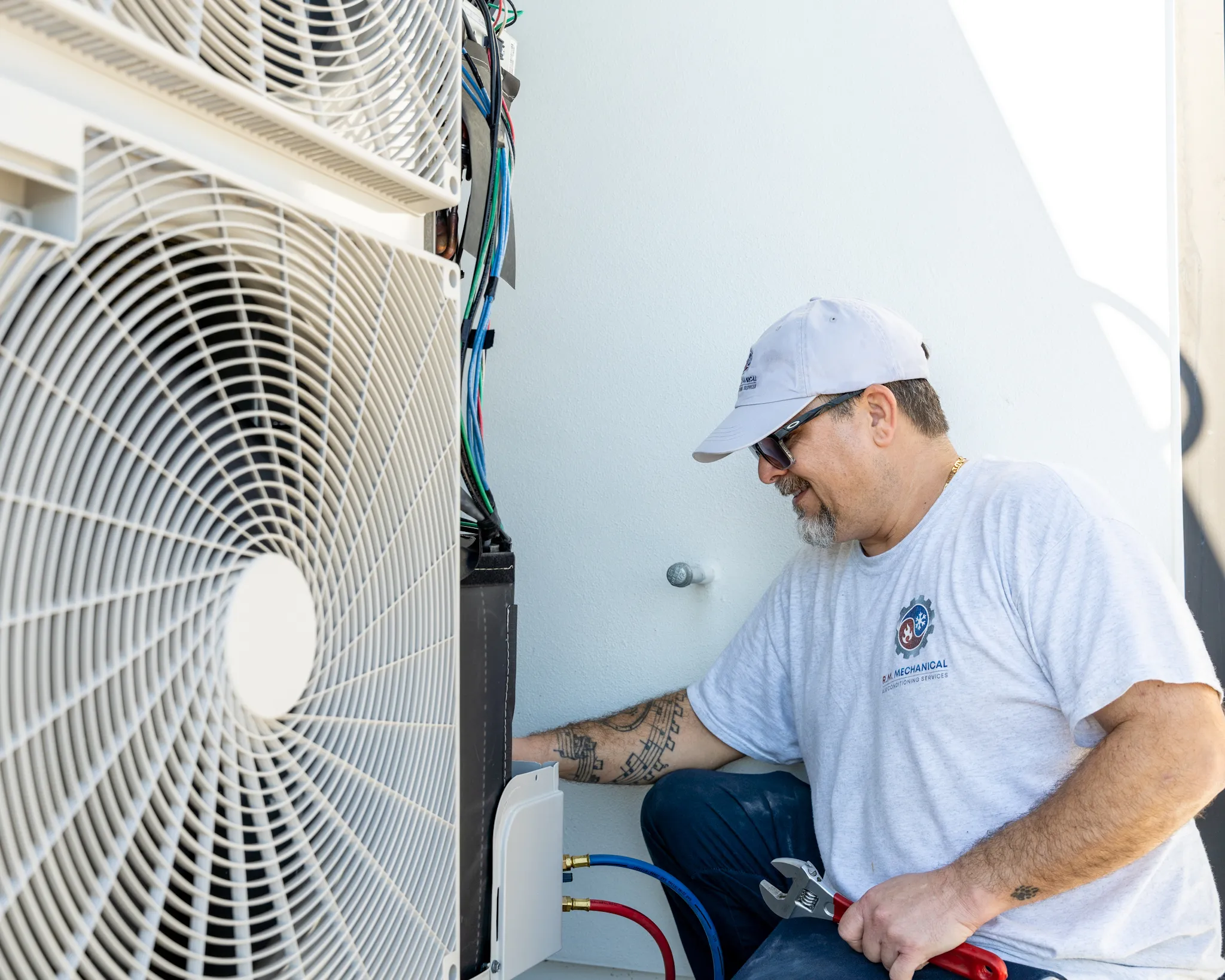
Refrigerant charge verified against manufacturer specification. Condenser and evaporator coils inspected and cleaned. Condensate systems cleared and safety devices tested. Electrical connections checked and torqued, with capacitors and contactors tested under load. Belt drives, bearings and motor amperage checked where fitted. Economizer operation verified on units that have one, since a failed economizer quietly wastes a great deal of energy without producing any obvious symptom.
Filters are the routine item, and on commercial sites they are usually the thing that gets missed between visits. We set a change interval from the filter loading we measure at your site, not from a default.
Twice yearly is the baseline for most rooftop and split systems in this climate: one visit before the cooling season, one during it.
Salt attacks condenser coils continuously along both shorelines. Sites in that band need more frequent coil attention than inland ones, and coil condition drives replacement timing more than mechanical wear does.
Restaurants, medical, data-adjacent spaces and anything running extended or 24-hour schedules accumulate wear far faster. Frequency should follow run hours, not the calendar.
Where a site has many units, we track them individually so replacement can be planned and budgeted rather than arriving as a series of surprises.
Every visit is documented per unit: what was found, what was done, and what is trending toward failure. That record does three jobs. It supports manufacturer warranty claims, which usually require evidence of professional maintenance. It gives you a defensible basis for capital planning rather than replacing equipment reactively. And it means the next technician on site is not starting from scratch.
For multi-tenant and managed properties, that documentation is also what you need when a tenant asks why a unit failed.
Maintenance that disrupts trading is maintenance that gets cancelled. We schedule around opening hours where the site needs it, including early mornings and after close, and we coordinate access with property managers so the business does not have to.
We work commercial and residential under the same license and the same technicians. See commercial HVAC for repairs, replacements and new installations.
Twice a year is the baseline for most rooftop and split systems in this climate. Sites with high run hours, heavy filter loading, or coastal salt exposure need more. The right answer comes from how the equipment runs at your site, which is why we look before quoting a frequency.
Yes. We track units individually so you get a history for each one, not a single site-level note. That is what makes replacement planning possible instead of reactive.
Yes. For retail, restaurants and anywhere that cannot lose trading hours, we schedule around opening times including early mornings and after close.
It is usually a condition of it. Most manufacturer warranties require documented professional maintenance, and claims can be denied without that record. We document every visit per unit so the paperwork exists if you need it.
Condenser coil condition and condensate problems, both driven by the climate. Coils foul and corrode faster in salt air, and the humidity means condensate systems are in near-constant use, so a blocked drain shuts a unit down at the worst possible time of year. Both are cheap to catch on a scheduled visit.
R.M. Mechanical works across Hillsborough, Pinellas, Pasco and Hernando counties. Open your area for the local details that actually change the job: which building department issues the permit, what the housing stock is like, and what the climate there does to equipment.
Tell us what you need and we will come back with a realistic scope. For an urgent failure, call instead 727-306-1700.
Thank you! Your message is on its way.
We check messages 6am to 7pm daily and will get back to you. Need help right now? Call 727-306-1700.
Something went wrong and your message didn't go through. Please try again, or call us at 727-306-1700.