A national article will tell you an air conditioner lasts fifteen to twenty years. In St. Petersburg, ten to fifteen is more honest, and on the waterfront it is often less.
That is not equipment quality. Three specific things about this city stack on top of each other, and only one of them is the weather.
You live on a peninsula
Very little of St. Petersburg sits more than a couple of miles from salt water. Tampa Bay on one side. Boca Ciega Bay on the other, with the Gulf just beyond that. The corrosivity band that actually matters extends roughly a mile inland from any of it, which covers most of the city and nearly all of the older housing in it.
What salt does is mechanical, and worth understanding, because it explains why the usual advice falls short here. Airborne salt settles on the aluminum fins of your outdoor coil. It holds moisture against them. Aluminum fins and copper tubing sit in direct contact, and salt plus moisture drives corrosion between the two metals. The fins thin. Then they perforate. Then the coil cannot reject heat the way it was designed to.
Here is the part that catches people out: nothing breaks.
Compressor is fine. Fan turns. The system still blows cold air, just less of it, for more electricity, every summer, and because the decline is gradual almost nobody catches it early. Most owners notice somewhere around the fourth or fifth year, usually because a power bill arrives that does not match the weather, and by that point the coil is generally past economical repair. It is why we look at fin condition before anything else on a coastal service call, and why a coated coil on a replacement here is a specification decision rather than an upsell someone invented to raise the quote.
The housing stock predates central air
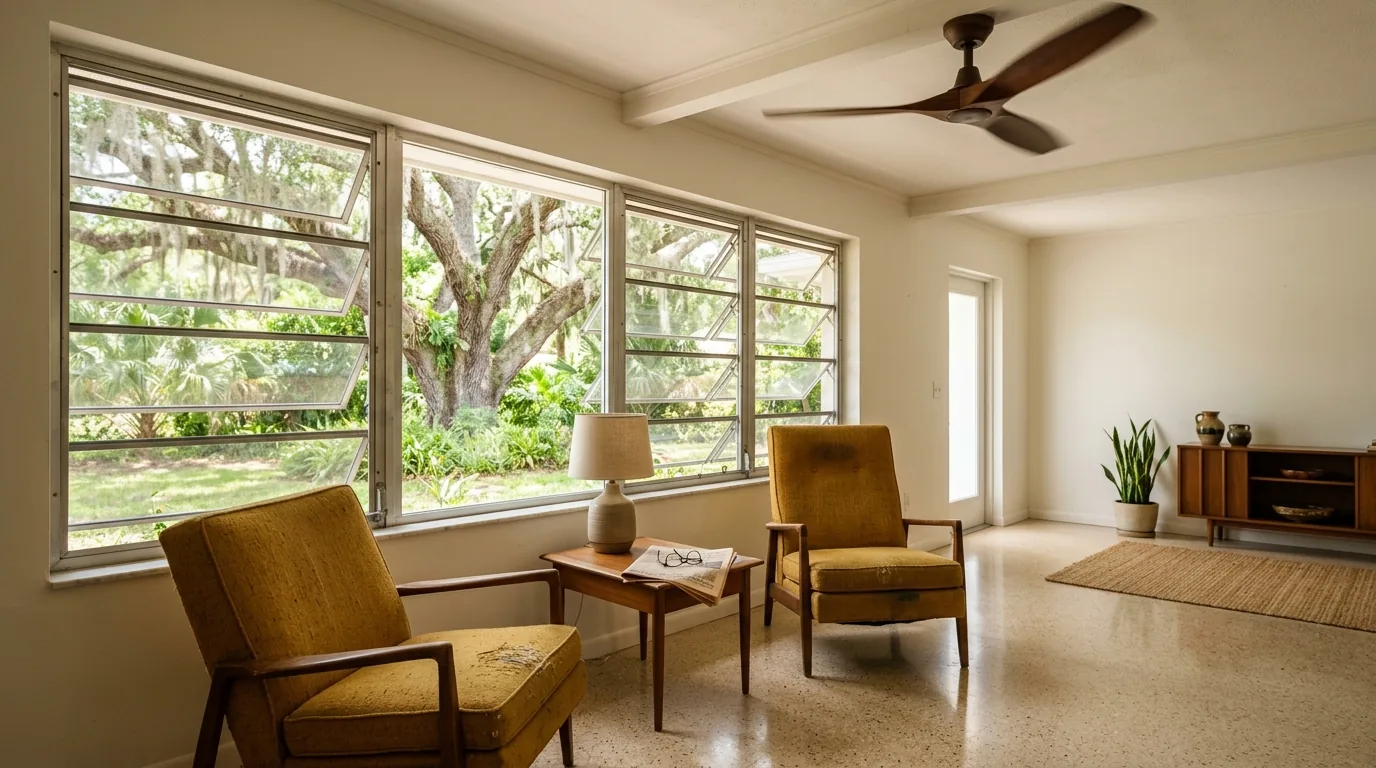
Large parts of this city went up before air conditioning was standard. The older neighborhoods around downtown, Kenwood, Old Northeast, Lealman: those houses were designed to work without it. High ceilings let heat stratify. Tall windows and transoms moved air through. Deep overhangs shaded the walls.
Then, decades later, someone threaded a duct system into them. The retrofit is where the compromises live.
Two show up again and again. The first is a single central return, one large grille in a hallway serving the whole house, which means every bedroom with its door shut is starved of airflow. Owners describe this as "the back bedroom never cools." It is not the equipment's fault and a bigger unit will not fix it.
Second problem: ductwork squeezed into whatever space existed. Soffits, attics, crawl areas, usually with more bends than a purpose-built system would have, and frequently undersized for the equipment now attached to them.
Put an oversized unit on that and it cycles harder against the same restriction. Short cycling means less dehumidification. In this climate that makes the house feel worse, not better.
The panel is sometimes the real constraint
A house wired in the 1950s was wired for the loads of the 1950s. Since then the same panel has often absorbed a modern range, a dryer, a pool pump, circuits from a remodel, and an air conditioner considerably larger than the original.
Most replacements are still a straightforward swap. But often enough to matter, an assessment turns up a panel with nothing left in it, undersized conductors, or a missing or non-compliant disconnect at the outdoor unit.
Better to find that at quote stage than halfway through an installation, which is why we look before we price.
What extends equipment life here
Roughly in order of how much difference each one makes on a St. Pete house:
- Service the coil twice a year, not once. Inland Florida can get away with an annual visit. Within a mile of salt water the coil needs attention in the middle of the season as well as before it, because corrosion does not pause for summer. This is the single largest lever on coastal equipment life and it is the one most often skipped.
- Specify a coated coil on replacement. It costs more up front. It is frequently the difference between reaching the end of the warranty period and not.
- Fix the return path. Transfer grilles or jumper ducts to closed bedrooms are inexpensive, and they address the complaint people usually blame on capacity.
- Rinse the condenser between visits. Plain water, power off at the disconnect, from the inside out where you can reach. Costs nothing.
- Keep landscaping back. Two feet all round. Hedges grown in against a condenser are one of the most common avoidable problems we find.
One local note on permits
St. Petersburg runs its own building department. A changeout inside the city limits is permitted through the city rather than Pinellas County, and unincorporated areas such as Lealman go through the county instead.
None of that matters to you as long as your contractor handles it. It matters a great deal if someone suggests skipping it, because an unpermitted installation was never inspected, and that surfaces later when you sell the house.
The short version
System around ten years old and cooling less well than it did? Look at the coil before the compressor. One room that has never worked properly is airflow, not capacity. And if someone quotes you a larger unit to solve either of those, ask to see the load calculation before you sign anything.
See HVAC service in St. Petersburg for what we cover locally, salt air and your AC for the corrosion detail, and the electrical panel question if your house is from that era.