Coastal HVAC specification costs real money. Coated coils add to the price of a replacement, and twice-yearly service costs more than annual service.
Both are obviously worth it on a barrier island. Both are obviously unnecessary in Plant City.
Most of Tampa Bay sits between those two, and a contractor who gives the same answer everywhere is either overcharging inland customers or under-protecting coastal ones. Here is how to work out which side of the line your address falls on.
The band is roughly a mile, and it is not a hard edge
ISO 9223 grades atmospheric corrosivity from measured corrosion, not from map distance, and corrosion engineers typically put the first mile or so from salt water, the Tampa Bay shoreline included, at C4 or higher, the same band as open coast. The exposure falls off with a steep gradient: strong within about a mile of salt water, weakening markedly beyond that, and negligible by three or four miles in most conditions.
Two things modify it.
Prevailing wind matters, so a property downwind of open water takes more than its distance from the shore would suggest, and a house with nothing but open bay between it and the prevailing breeze is effectively closer than the map says. Obstruction cuts the other way: dense development or heavy tree cover between you and the water reduces what reaches your coil, which is why two houses the same distance from the same shoreline can age their equipment at noticeably different rates.
Clearly inside the band
These need coastal specification without much debate. The barrier islands and the immediate shoreline on both sides of the peninsula:
Clearwater Beach and Sand Key, Indian Rocks Beach, Indian Shores, the Redington beaches, Madeira Beach, Treasure Island, St. Pete Beach, Gulfport, Hernando Beach, and the waterfront strips of Dunedin, Tarpon Springs, Port Richey and Holiday.
Bay-side counts too: canal-front Apollo Beach, the Ruskin shoreline, waterfront Oldsmar and Safety Harbor. Tampa Bay is salt water and behaves like it.
Clearly outside it
These do not need it, and money spent there is money that should have gone into ductwork:
Brandon, Valrico, Riverview, Fish Hawk, Plant City, Wesley Chapel, Land O' Lakes, Zephyrhills, Lutz, Odessa, Brooksville, Dade City and the rural eastern county.
The judgment calls
These are the addresses where it depends on the street, not the town, and where it is worth asking instead of accepting a default:
Largo, Seminole, Palm Harbor, Clearwater east of the intracoastal, St. Petersburg away from either shore, Elfers, Hudson, western Spring Hill, and Pinellas Park.
In each of those, two houses a mile apart can genuinely warrant different specifications.
How to check without taking anyone's word for it
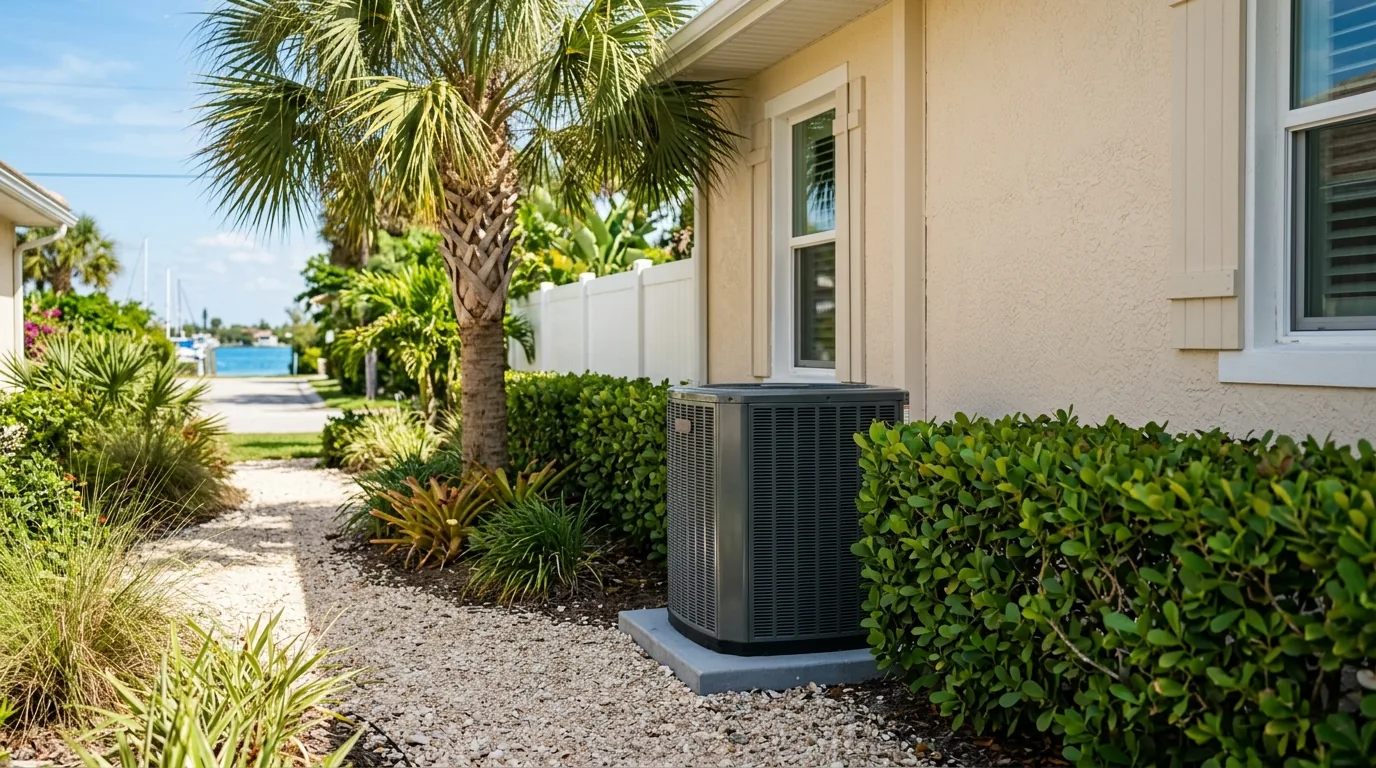
You do not need a contractor to answer this. Go and look at your existing outdoor unit.
- White powdery deposit on the fins is aluminum oxidation, and it means salt is reaching you.
- Fins that crumble or flake under light finger pressure are well past the early stage.
- Rusted cabinet screws and panel edges after only a few years is a strong signal.
- Ask a neighbor how long their last system lasted. Consistent eight-to-twelve-year lifespans along a street point squarely at corrosion, whereas fifteen-plus tells you the salt is not reaching that far and you can stop worrying about it.
That last one is the most useful piece of evidence available and it costs a conversation over a fence.
Do the fin inspection with the power off at the disconnect, and look at the side of the cabinet facing the water, not the side facing your driveway. Corrosion is directional. A coil can be pristine on the sheltered face and half eaten on the exposed one, and an owner who checks only the convenient side walks away reassured for the wrong reason. While you are back there, shine a light through the coil from the outside. If you cannot see daylight through most of the fin pack, the coil is loaded, and loading traps salt against the aluminum where it does the most damage.
What a service visit looks like inside the band
A coastal maintenance call is longer than an inland one, and the extra time goes almost entirely into the outdoor unit. The technician pulls the top or the access panels instead of spraying through the guard, rinses the coil from the inside out so salt and dirt exit the way they came in and are not driven deeper into the fin pack, and then inspects what is left of the aluminum. That last part is the piece owners rarely get told about. Fin condition is the number that predicts when the system dies, and a technician who has looked at it can tell you whether you are looking at years or seasons.
Everything else on the visit is ordinary: refrigerant charge verified against measured conditions, not a glance at a gauge, capacitor measured, not eyeballed, contactor contacts checked for pitting, condensate line cleared, and the blower and evaporator inspected indoors.
Cabinet hardware gets attention too, which sounds trivial until you have met a unit whose screws sheared off in place.
The interval question is simpler than it sounds. Inside the band, twice a year works because the mid-season rinse interrupts the corrosion cycle partway through the wettest, saltiest stretch of the year rather than letting eight months of deposit sit and work. Outside the band, an annual visit does everything a second one would, and paying for a second is paying for a rinse that removes dust.
What to do with the answer
Inside the band: specify a coated coil at replacement, service the coil twice a year rather than once, and rinse the condenser with plain water between visits with the power off at the disconnect. Those three together are the difference between reaching normal service life and not.
Outside it: do not pay for coil coating you will never benefit from. Put the money into duct sealing and envelope work, which is where the return is inland.
In the middle: ask specifically why the recommendation applies to your address. A good answer references your distance from water, your exposure, and the condition of your existing coil. A bad answer is that everyone in Florida needs it.
One practical note on replacement, wherever you land. Every municipality and county in this region requires a mechanical permit for a changeout, and an inspection follows it. Coastal or inland makes no difference to that requirement, but it does make a difference to what the inspector is looking at, since equipment near the water gets scrutiny on mounting, elevation and electrical protection that an inland unit does not attract. Any contractor pulling the permit handles this. A contractor suggesting you skip it is telling you something useful about the rest of the job.
See salt air and your AC for the mechanism, maintenance plans for what a coastal visit covers, and all our service areas.