Before you buy a replacement thermostat, check the batteries, then check both breakers, then look in the drain pan under your air handler. In our experience the majority of dead thermostats in Tampa Bay are not dead thermostats at all. Something upstream cut their power. The device on the wall is only the messenger.
The two checks that solve most of these
Batteries first. Plenty of thermostats carry batteries even when they are wired to the air handler, and a flat set produces a completely blank screen that looks exactly like a failed unit. It takes two minutes and costs a few cents. Do it before anything else, and do it even if you are sure you replaced them recently, because "recently" has a way of meaning eighteen months.
Then the breakers. Most homes have two involved: one feeding the indoor air handler and one feeding the outdoor condenser. A thermostat drawing its power from the air handler goes dark the moment that breaker trips. Reset it once. If it holds, you had a nuisance trip and you are done.
If it trips again immediately, stop.
A breaker that will not hold is reporting a real electrical fault, usually a shorted motor, a failed contactor or a compromised conductor. Resetting it repeatedly is how a fault becomes a fire. That one is a service call, not a homeowner job, and the electrical side of an HVAC system has its own set of rules worth knowing about in an older house.
The blank thermostat that is working perfectly
This is the one almost nobody guesses, and in a Tampa August it is the single most likely explanation of the three.
Your air conditioner pulls water out of the air continuously. That water lands in a drain pan and leaves through a condensate line. When that line clogs with the biological slime that grows in warm, wet PVC, the pan fills. A float switch sitting in the pan then deliberately cuts power to the system so the pan cannot overflow into your drywall. On a very large number of Florida installations, that same switch kills the 24 volt circuit feeding the thermostat. Blocked drain, dead thermostat, no relationship that is obvious from the hallway.
So go look. Standing water in the pan under the air handler is your answer, and the thermostat you were about to replace has just saved you a ceiling. Condensate problems explained covers what to do next.
Eight months of continuous dehumidification is why this fault is so common here and so rare in Denver.
Settings that impersonate a fault
Sometimes the system is fine, the thermostat is fine, and the configuration is quietly working against you. Run through these before assuming hardware:
- Mode. Cool, with the setpoint actually below current room temperature. Auto mode hides which side the system is trying to satisfy and confuses more homeowners than it helps.
- Fan on ON rather than AUTO. ON runs the blower continuously, so air keeps coming out of the vents even when no cooling is happening. This reads to a homeowner as "it runs constantly but never cools," and it also re-evaporates condensate off the wet coil back into your house, which makes the place feel clammy.
- Compressor short-cycle delay. Nearly every modern system enforces a three to five minute lockout before the compressor may restart, protecting it from starting against high head pressure. A system that does nothing for several minutes after you drop the setpoint is frequently just waiting out that timer.
- A schedule you forgot about. Power flickers reset clocks. A thermostat that reverted to a factory schedule will keep overriding whatever you set by hand, at the same time every afternoon.
When the thermostat is right and the house is wrong
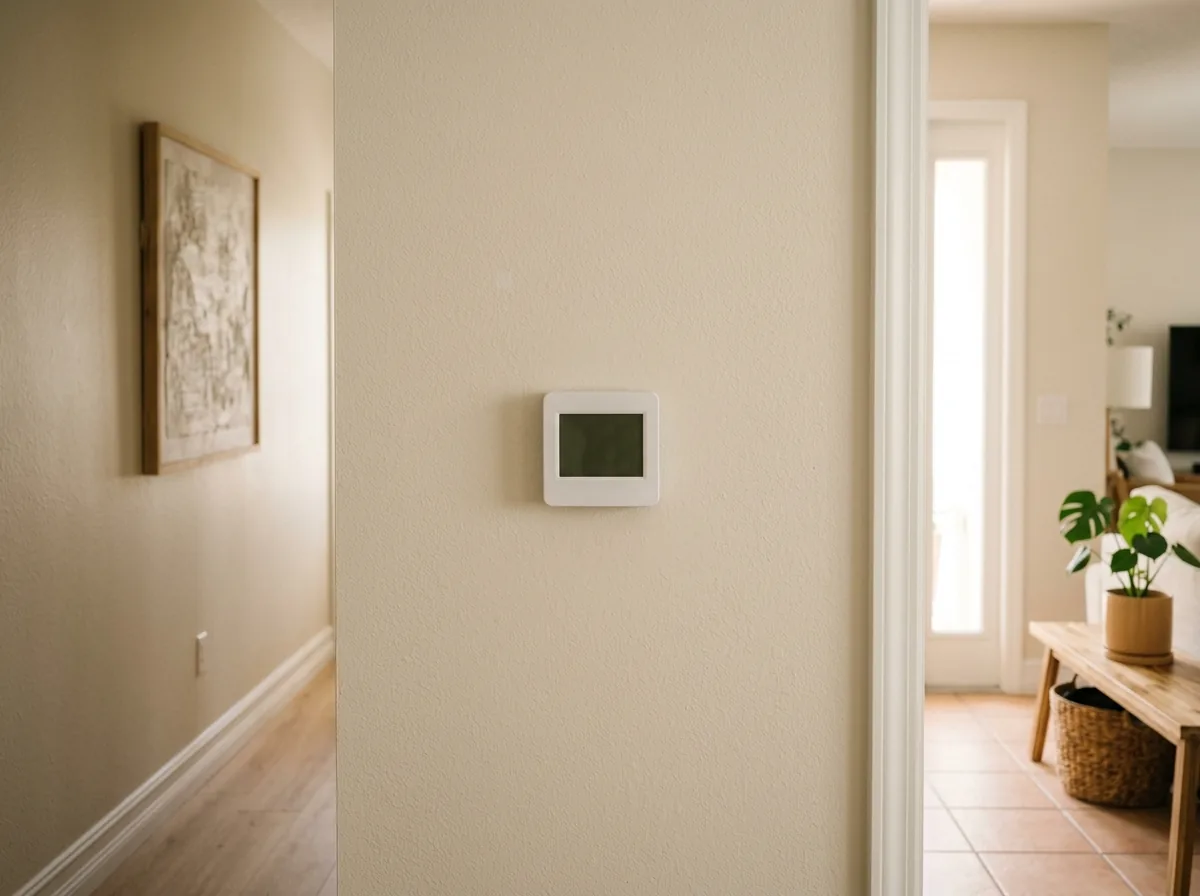
One sensor, on one wall, deciding the temperature of an entire house. Put that sensor somewhere unrepresentative and every decision downstream inherits the error.
Afternoon sun falling on the wall will do it. So will a spot on an exterior wall in an older, lightly insulated house, an air path from a nearby supply register blowing conditioned air straight across the sensor, or the waste heat of a lamp, a router or a television sitting below it. In each case the thermostat reads a temperature that no one in the house is actually experiencing, and it runs the equipment to satisfy that fiction.
Different symptom, different cause: if the thermostat reads accurately and the hallway is comfortable but the back bedroom is always six degrees off, the thermostat is not your problem at all. That is airflow, duct design, or a case for zoning, and we walk through the diagnosis in why one room is always hotter.
When replacement is the answer
Cracked display, unresponsive buttons, settings that will not stick, or a unit that has visibly corroded: replace it. That much is simple. Two things trip people up at the store.
The C wire. Smart thermostats need constant power rather than the trickle a mechanical thermostat lived on, and that requires a common conductor. Plenty of Tampa Bay houses were wired with four conductors and no common. Adapters and power-stealing workarounds exist, and some work better than others, but this is a question to settle before you open the box, not after.
Heat pumps and communicating equipment. A heat pump with electric strip backup needs a control that stages that backup intelligently. Fit the wrong one and it will happily run resistance heat on a 55 degree morning when the heat pump alone would have handled it, at several times the operating cost. Variable-speed and communicating systems go further still: many require the manufacturer's own control, and installing a popular third-party smart thermostat can switch off the modulating behavior you paid extra for. See heat pumps and thermostats for what pairs with what.
Batteries changed, both breakers checked, drain pan dry, and the screen is still black? Now it is worth a proper diagnosis. We cover all four Tampa Bay counties, and you will be quoted before any work begins.