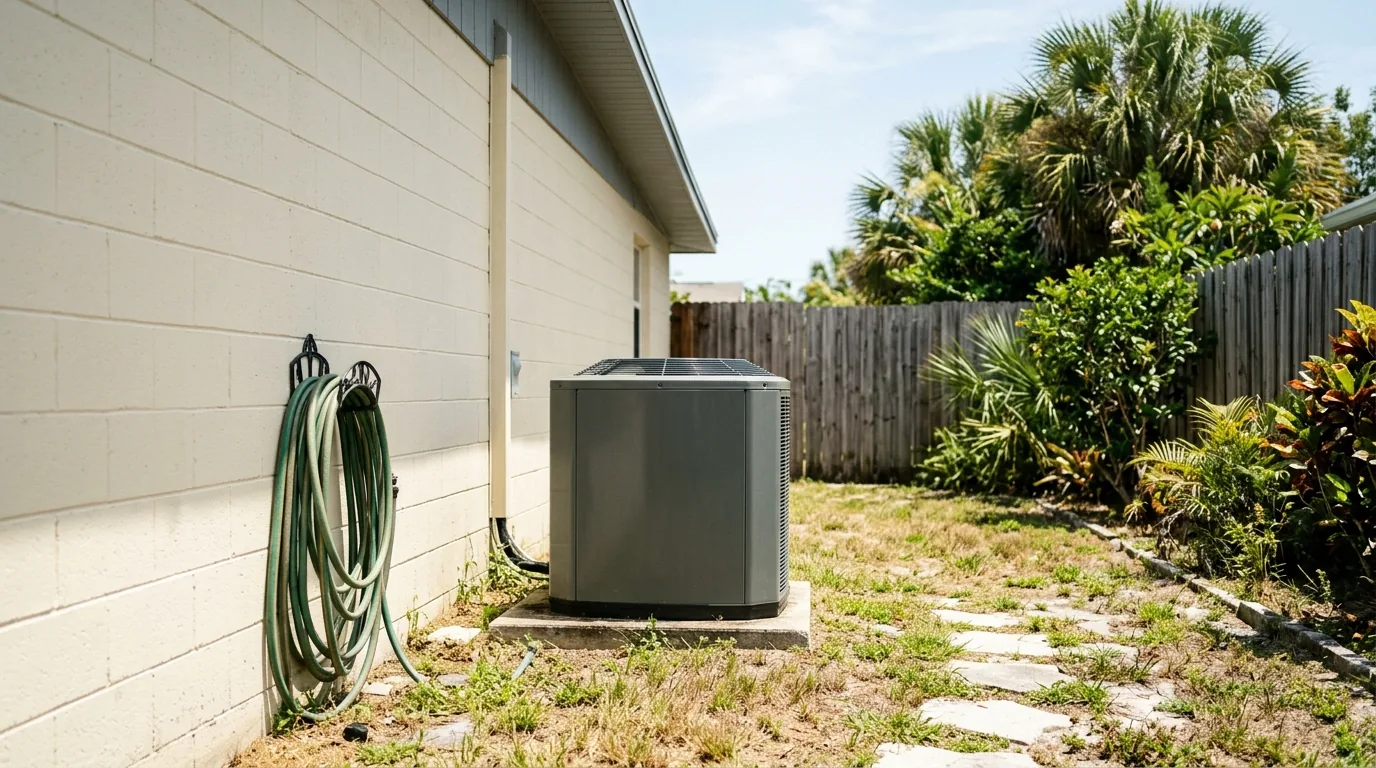
When the outdoor unit hums but the fan blade sits still, the answer is the capacitor more often than everything else combined. It is the part we see fail most often across Tampa Bay in summer, consistent enough that the pattern is recognizable over the phone before a truck ever rolls.
Small cylinder, big job.
A run capacitor stores the jolt of energy that shoves a motor from standstill into rotation, then steadies its running current afterward. Your condenser has two motors leaning on it: the fan up top and the compressor inside. Weaken that capacitor and those motors ask for their push, then get a shrug. Whichever one loses first sets the symptom, so you get a fan that will not spin, a compressor that will not start, or a whole system that clicks, tries, and gives up in rounds.
Florida heat is why it fails here first
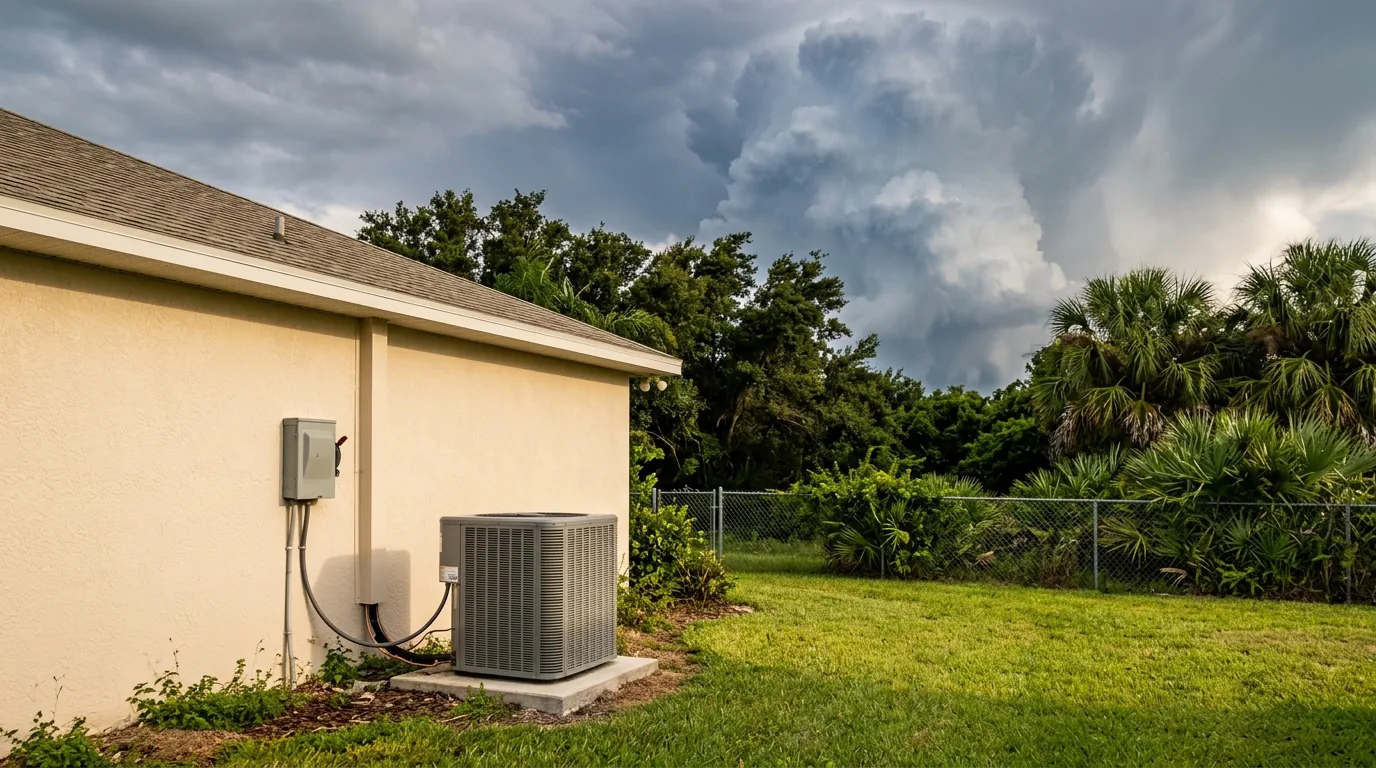
Capacitors die of temperature. The electrolyte inside degrades faster the hotter it runs, and the life ratings on these parts, tens of thousands of hours, assume the component stays near its design temperature. That sounds like decades until you remember where the part lives: inside a metal cabinet on a concrete pad, in direct sun, in a state where that cabinet spends every afternoon from May to October well above what the rating contemplates.
Voltage does its share too. Tampa Bay's lightning, plus the sags and spikes that ride the grid through storm season, stresses the part with every event, which is why we treat surge protection for AC equipment as its own subject.
Brownouts deserve a mention of their own. Line voltage that sags rather than failing outright leaves motors trying to run on less than they need, current climbs to compensate, and everything electrical in that cabinet gets a little older than the calendar says. Late-afternoon sags during a regional heat event do this quietly, across a whole neighborhood, and the failures show up over the following weeks rather than that night.
Heat plus voltage explains why capacitor calls stack up in July and August instead of spreading through the year. Whatever was marginal in March meets the season built to expose it.
The symptoms, in the order we hear them
- Humming outside, fan not turning. Classic presentation, and the one most people describe on the phone. Some homeowners have learned to poke the blade with a stick to get it spinning. Read the warning below before you consider joining them.
- Fan runs, nothing gets cold. On a dual capacitor, the compressor side can fail while the fan side still works.
- Clicking, straining, giving up. The system attempts a start, draws hard, drops out, and sometimes takes the breaker with it. That crossover comes up often enough that our breaker-tripping guide covers it from the other direction.
The part is cheap. The diagnosis is what you pay for
A capacitor is an inexpensive component, and swapping one takes minutes. Value in the service call sits elsewhere. One story is a capacitor that died of age and heat. The other is a capacitor that was killed, by a fan motor with dragging bearings or a compressor that has been starting hard for months, and dropping a fresh part into that second story buys you a few weeks before the same failure returns.
So the real work is confirming which story you are in. Measuring what the capacitor actually delivers against the microfarad rating stamped on its side comes first, then watching what each motor draws under load once the new part is in. A part that has drifted well below its stamped value has been failing for a while, not since Tuesday. Bulged tops do identify a dead capacitor; a flat top certifies nothing, and eyeballing the can is not a test. Under-load testing is already on the checklist for our maintenance visits, which is where weak capacitors get caught in April instead of failing in August.
A technician who swaps the part without asking why it failed may be back within a month. Ask the why question.
Why this is not a YouTube job
Capacitors hold their charge after the power is off. Storing charge is the entire point of the part, which means pulling the disconnect does not make the terminals safe to touch. Discharging one safely takes a specific procedure, and the stick trick for a stalled fan puts your hand inches from a blade driven by a motor that is already overheating. Neither risk is worth taking for a part every service truck carries.
There is a parts-counter version of this mistake too. Capacitors are sold by microfarad value and voltage rating, dual and single, and the wrong value fitted to the right terminals will run a motor outside its design envelope until something more expensive gives out. Matching the part is not the same as reading the number on the old one, because the old one may have been wrong since the last person guessed.
Shut the system off at the thermostat instead, so a stalled motor stops cooking, and book an AC repair. Leaving it humming against a seized start is the reliable way to turn a small repair into a compressor replacement.
Caught early, this is one of the quickest fixes in air conditioning. Caught late, it is a compressor.