The useful thing to understand about spring in Tampa Bay is that it is not a season so much as a narrow window. Cooling demand starts climbing in March, and by the second week of May the system is carrying close to a full summer load every afternoon. What you do in that window determines whether the next eight months are uneventful.
The point of a spring check is not tidiness. It is load. Everything below is aimed at one question: will this equipment hold up when the outdoor temperature sits at 93 degrees with a 75-degree dew point and the compressor runs most of the afternoon?
Run it under real load, on purpose
Start with the test, not the housekeeping, because the test tells you whether the rest of the list is urgent.
Wait for a warm afternoon, ideally one in the mid-eighties, and set the thermostat four or five degrees below where the house currently sits. You want the system to run continuously for at least twenty minutes rather than satisfy in six. That sustained run is the whole point. Plenty of systems will start, blow cold for five minutes and look perfectly healthy, and then reveal a weak capacitor, a low charge or a restricted airflow problem only after the coil has had time to reach steady state. During that run, check the temperature of the air coming out of a supply register close to the air handler against the air going into the return. A healthy split lands somewhere around 16 to 22 degrees. Much less than that and something is wrong; much more, and airflow is probably restricted.
Listen to the outdoor unit while it runs. A hard, momentary grunt at startup, a compressor that hums before it engages, or a fan that hesitates all point at electrical components that will not survive July. Those noises are worth a diagnosis while the weather is still forgiving.
Filter and airflow, before demand doubles
Put in a fresh filter and then look closely at the one you removed. It is the only piece of diagnostic evidence in the house that a homeowner can read without tools.
A filter uniformly gray after four weeks in a home with no pets and no construction next door usually means the return side is leaking, pulling attic air into the system downstream of where the filter can catch it. A filter dirty only in one corner points at bypass, meaning air is sneaking around the frame instead of through the media. And a filter that looks nearly clean after eight weeks in Florida is not proof of clean air; it more often means airflow is low enough that the filter is not seeing much air at all.
Choose the highest MERV rating your equipment is rated for and stop there. Going higher is a common and expensive mistake: a dense filter in a system whose blower cannot overcome the added static pressure cuts airflow, which cuts both capacity and dehumidification, and in the worst case drops coil temperature far enough to freeze it solid. See the guide to filters for how to read the rating on your system.
Service the drain now, because it is about to work continuously
From April through November the condensate system runs nearly nonstop, pulling several gallons of water a day out of the air in an average Tampa Bay house. That is the load it is walking into.
Clear the line before the season, not after it clogs. Check the drain pan under the air handler for standing water, which is itself a sign the line is already partly restricted. Confirm the line discharges outside where you think it does, and that the termination is not buried in mulch or blocked by a wasp nest. Verify the float switch works, since that switch is the only thing standing between a blocked drain and water in your ceiling.
Blocked drains do not fail in April. They fail on the most humid day in August, at the exact moment the system is condensing the most water it will condense all year. Details in condensate problems explained.
Give the condenser room to work
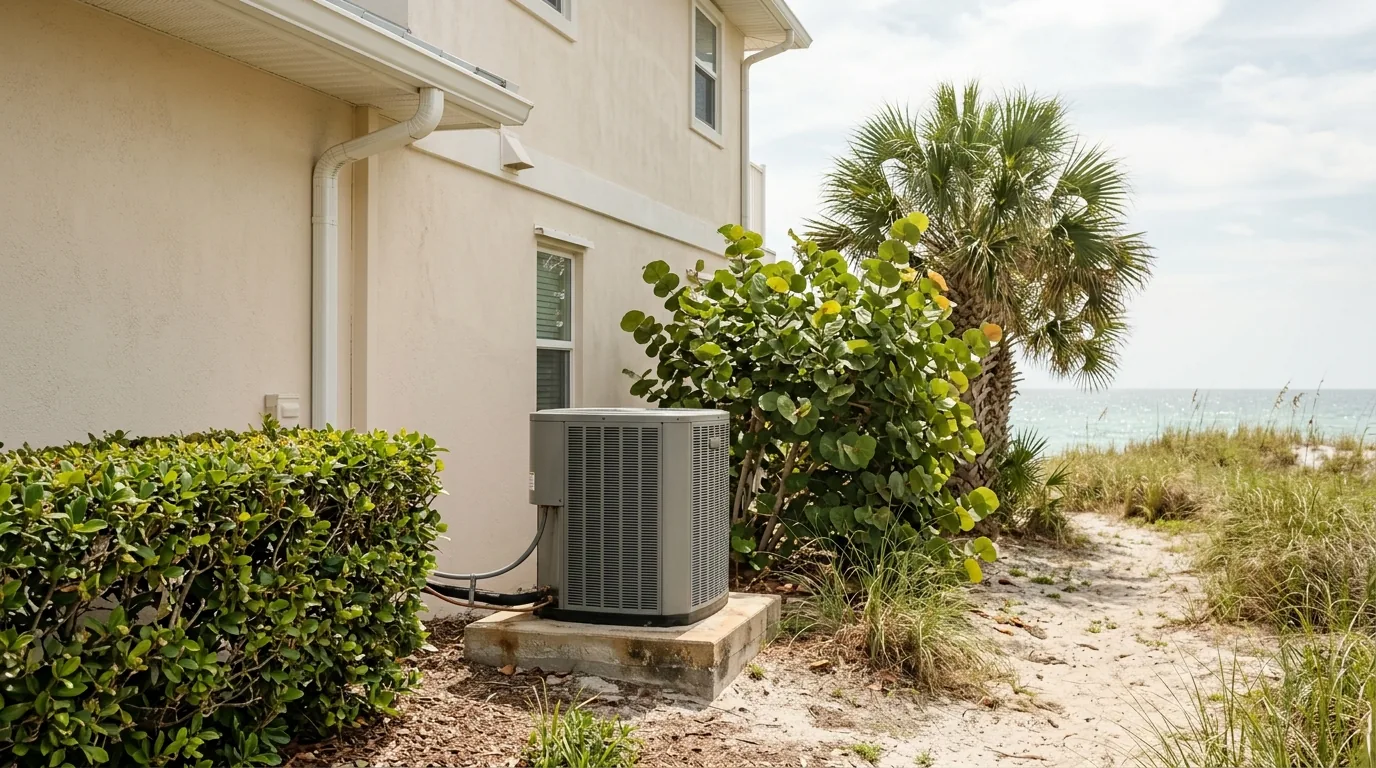
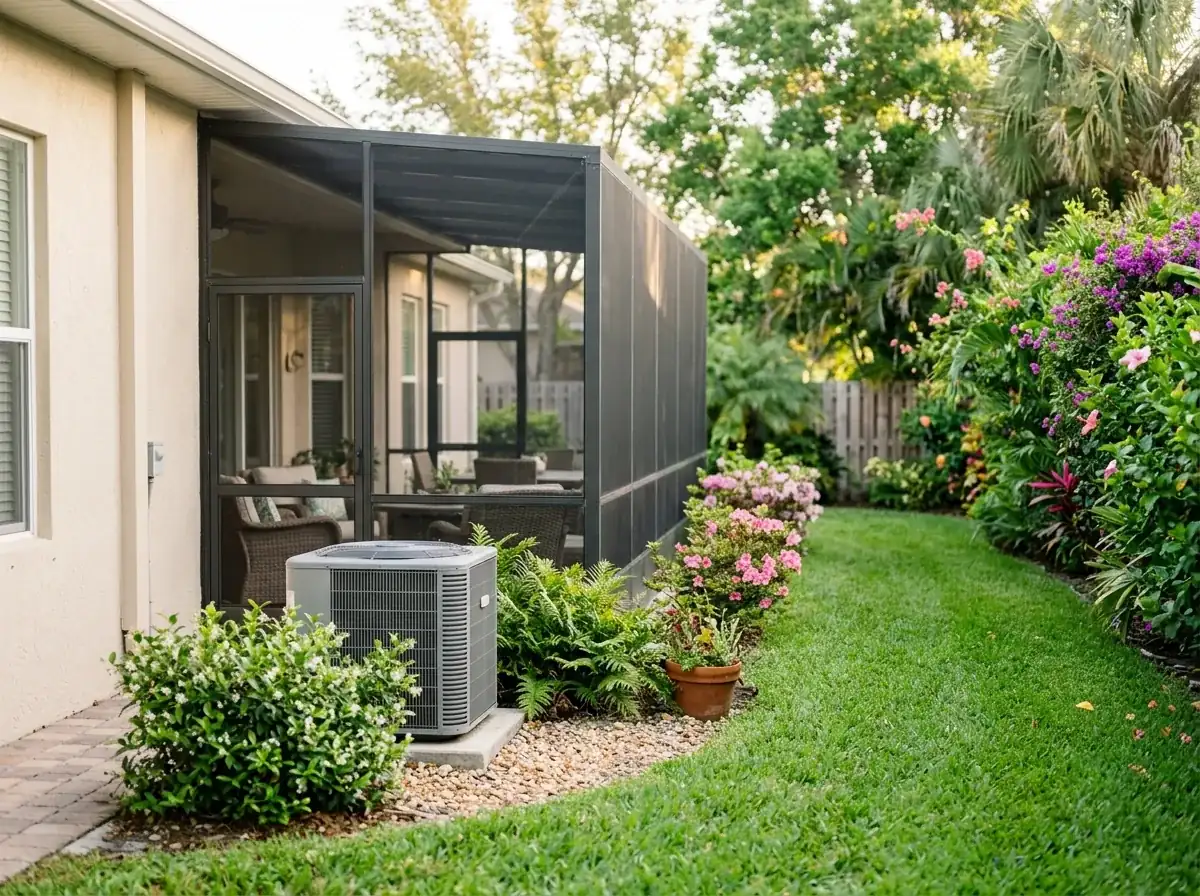
Winter growth crowds outdoor units, and heat rejection is exactly what the condenser is about to be asked to do at maximum. Clear two feet of open space on all sides, cut back anything that has grown over the top, and pull out the leaf litter that collected against the coil face.
While you are down there, look hard at the fins. Corrosion or flattening costs capacity directly, and near the water it is the leading reason a unit ages faster than its calendar years suggest.
Verify the charge before the first 95-degree day
This one requires a technician, and it is the single most valuable thing in the spring visit.
Refrigerant charge is not something you top off like oil. A system that is low is leaking, and the charge must be verified against the manufacturer's specification using superheat or subcooling measurements taken while the system runs under load. Mild spring weather masks a low charge, because a system that is ten percent undercharged will still cool a house comfortably at 82 degrees outside and then fall well short at 95. Which is why verification in March is worth far more than a complaint in June. See what low refrigerant really means.
The same visit should measure the run capacitor rather than eyeball it, torque the electrical connections, clean both coils and check static pressure across the air handler. Capacitor testing earns its place at the top of that list, because a capacitor is cheap while it is still working and can take a compressor with it when it is not. Coastal homes want this twice a year; inland homes are fine on once, done in spring. See maintenance plans.
Reprogram for a humid climate, not a northern one
Most thermostat schedules are set up around advice written for dry summers, and that advice actively costs money here.
- Set the fan to Auto. On the On setting, the blower keeps moving air across a coil that is still wet after the compressor stops, which evaporates that moisture straight back into the house. You paid to remove it twice.
- Keep setbacks shallow, two or three degrees, not eight or ten. A deep setback in Florida means the house also gains humidity while you are out, and the recovery period spends its energy on latent load before it gets around to temperature.
- New batteries.
- If your thermostat reports runtime, note roughly what a normal April day looks like. That baseline earns its keep in July, because rising runtime at steady weather is the earliest signal you get that something has degraded. A smart or programmable thermostat makes this automatic.
Handle surge protection now, not during a watch
Hurricane season opens June 1 and overlaps the hottest weeks of the year, so storm prep and peak cooling demand arrive together, which is an unfortunate piece of scheduling nobody consulted us about. Spring is when to sort out surge protection at the outdoor unit, confirm how the equipment is anchored to its pad, and find out whether your line set is strapped properly. Do it in April. Not with a cone on the map.
We cover all four Tampa Bay counties, and spring appointments are considerably easier to get than August ones.