Salt is eating your condenser, and it started the day the unit was set on the pad. Homeowners near the water tend to think of corrosion as something that shows up at year ten, a cosmetic issue on an old machine. It is neither cosmetic nor slow. Airborne salt begins working on the outdoor coil immediately, and by the time you can see white powder blooming between the fins, the aluminum has already lost thickness it will never get back.
Which is why a coastal system that looks fine can be running at a fraction of the capacity it shipped with.
How salt attacks the metal
Your outdoor coil is a sandwich of two dissimilar metals. Copper tubing carries the refrigerant, and thin aluminum fins are pressed onto that tubing to give the heat somewhere to go. Put those two metals in contact and add an electrolyte, which is exactly what a film of salt water is, and you have built a battery. Current flows. The aluminum, being the less noble metal, gives up material to protect the copper. Engineers call it galvanic corrosion. You will recognize it as fins that crumble to powder when you brush them with a fingertip.
Salt makes this worse in a second way that gets less attention. Sodium chloride is hygroscopic, meaning it pulls moisture out of humid air and holds it against the metal. A salt deposit on your coil does not dry out overnight the way plain dust does. It stays damp through the night, through every overcast morning, through every stretch of August when the dew point sits near 75. The electrolyte is basically never absent.
Copper corrodes too, just more slowly and in a different pattern. On copper the failure mode is formicary corrosion, sometimes called ant-nest corrosion, which bores microscopic branching tunnels through the tube wall until refrigerant finds its way out. That is the leak nobody can locate with a sniffer because it is not one hole, it is a thousand.
What fails first, and in what order
Fin degradation comes first, usually within the first three or four years within sight of salt water. Heat transfer drops because the fins are thinner and the bond to the tube has loosened, so the compressor runs longer to move the same heat. Nothing breaks. Your bill just creeps.
The cabinet and fasteners go next. Screws seize and snap, the base pan rusts through, panel edges bloom orange, and a technician who needs to open the unit for an unrelated repair now needs to drill out hardware. Small thing, but it turns short visits into long ones.
Then come the electrical components. Contactor points pit and weld, capacitor terminals corrode, and the low-voltage connections at the disconnect grow a green crust that raises resistance until the contactor chatters. A surprising share of coastal no-cool calls are really corrosion at a connection, not a failed part.
Refrigerant leaks arrive last, and they arrive as a verdict. Once formicary corrosion has perforated a coil in several places, patching is not a repair, it is a delay.
What coil coatings and corrosion-resistant cabinets buy you
A factory coil coating is a thin polymer or epoxy layer applied to the fin-and-tube assembly under controlled conditions, usually by e-coat immersion so the film reaches surfaces a spray gun cannot. Its job is simple: keep the electrolyte from touching bare metal. It does not stop corrosion forever. It buys years, and near salt water those years are worth real money.
Aftermarket spray coatings applied to a coil already in service are a different product entirely. They cannot reach the interior fin surfaces where most of the attack happens, they add thermal resistance where you least want it, and applied heavily by an enthusiastic installer they measurably cut capacity. We do not recommend them.
Corrosion-resistant cabinets matter more than people expect. Galvanized steel with a powder coat is the default and it fails at the cut edges and screw penetrations, because that is where bare steel is exposed. Coastal-rated cabinets use heavier zinc coatings, stainless hardware, and composite base pans that cannot rust at all. When you are pricing a coastal replacement, ask what the base pan is made of. It is a better question than most people ask.
One honest caveat. A coated coil in a house half a mile from open water is money well spent. The same coating on a house five miles inland is money spent on a problem you do not have.
How close is close enough to worry
ISO 9223, the standard corrosion engineers use, grades environments by measured metal loss rather than by distance, and the first mile or so from salt water typically grades out at C4 or higher, the high-corrosivity end of the scale. Inside that mile, treat coastal protection as standard rather than optional.
The bay counts. Apollo Beach and Ruskin front Tampa Bay, not the Gulf, and the water there is salt water with wind blowing off it. Bay Pines and South Pasadena front the intracoastal, same story. The corrosion does not know which body of water it came from. Meanwhile a place like Timber Pines sits about three miles inland and simply does not have this problem, whatever a salesman tells you. For a street-by-street picture, our guide to which Tampa Bay neighborhoods need coastal HVAC protection maps it out.
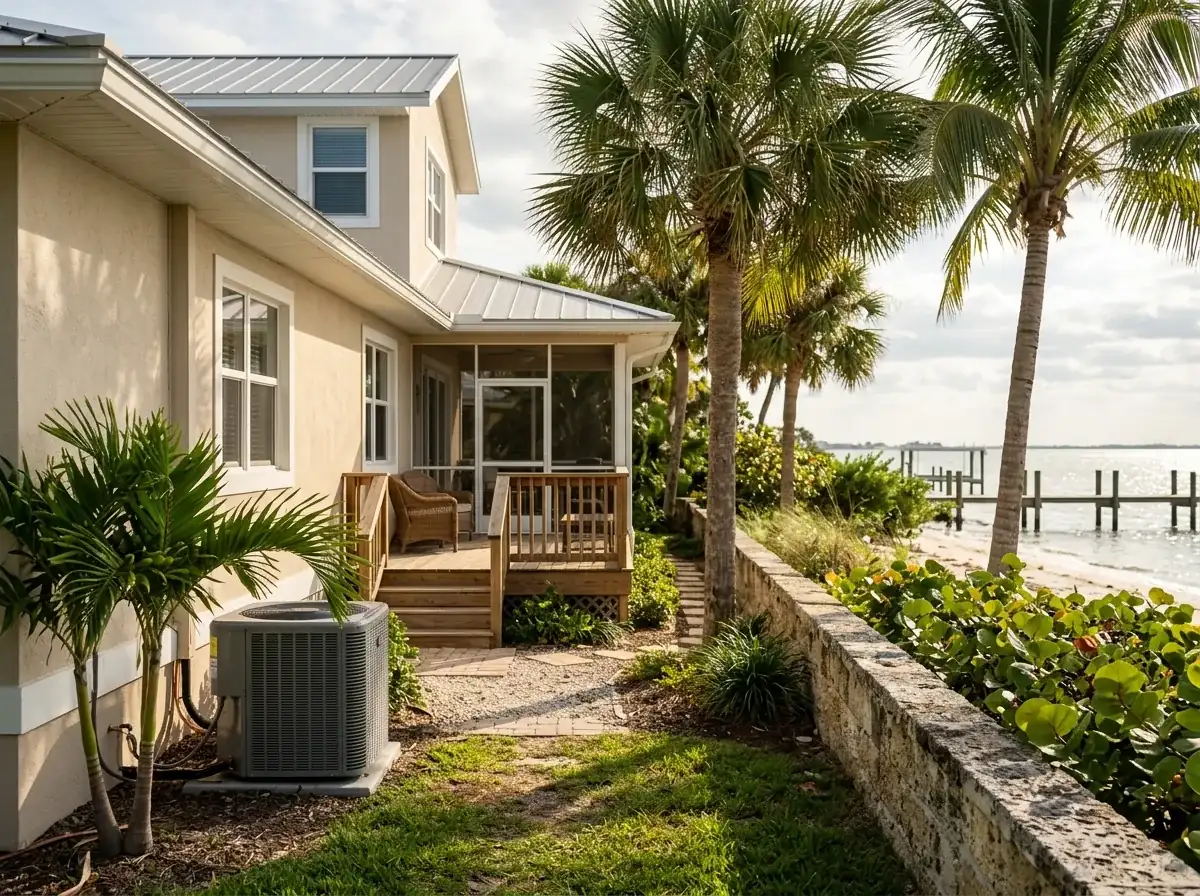
Wind exposure modifies all of this. A condenser on the seaward side of the house, in open air, takes several times the salt load of one tucked behind the garage on the lee side. Placement is a decision you make once, at installation, and then live with for fifteen years.
Rinsing: how often and how to do it right
Fresh water rinse every three months inside the first mile, every six months out to about three miles. This is the single most valuable thing a coastal homeowner can do for their equipment, and it costs nothing but twenty minutes.
Kill power at the outdoor disconnect first. Use a garden hose at ordinary household pressure, no nozzle attachment that concentrates the stream. Spray from the inside of the coil outward wherever you can get the hose past the fan grille, because salt and debris entered from the outside and you want to push them back out the way they came rather than driving them deeper into the fin pack.
Never use a pressure washer. Fins fold flat at pressures far below what a consumer washer produces, and folded fins block airflow permanently. You will have traded a corrosion problem for an airflow problem, and the airflow problem is worse.
Skip the household detergents and the acidic coil cleaners sold for the purpose. Acid brighteners strip the aluminum oxide layer that was slowing the corrosion down. Plain water, more often, beats chemistry.
How coastal life changes the maintenance calendar
- Twice-yearly professional service instead of annual. The second visit is not upselling. It exists so somebody with a meter catches a pitting contactor or a fin pack losing structure while it is still a small conversation.
- Line set insulation, checked every visit. UV and salt destroy it, and bare suction line in Florida humidity sweats and drips.
- Electrical connections cleaned and retorqued. Corroded terminations run hot, and heat is what kills contactors.
- Plan on a shorter service life. Twelve to fifteen years is a reasonable expectation inland. Close to salt water, plan around ten to twelve and be pleasantly surprised.
- Do not build a shed, box, or decorative enclosure around the unit to shelter it from salt. Restricting airflow raises head pressure and shortens compressor life faster than salt ever would.
Our maintenance plans are built around that twice-a-year rhythm, and we work coastal properties across Pinellas, Hillsborough, Pasco and Hernando counties. If your system is already showing white bloom in the fins, a look now is worth more than a look next spring.