A pool heat pump and the heat pump conditioning your house run on identical physics. Neither one creates heat. Both move it from one place to another, which is why they cost a fraction of what resistance heating costs to operate, and why Florida is close to an ideal climate for both. Understanding one teaches you most of what you need to know about the other.
One clarification before we go further. Our company installs and services HVAC equipment, not pool equipment, so treat what follows as background on how the two systems relate and where they intersect at your electrical panel. Your home comfort system is squarely our work. Pool equipment service is not, and any contractor who claims both should be asked which one they actually do every day.
How a pool heat pump works
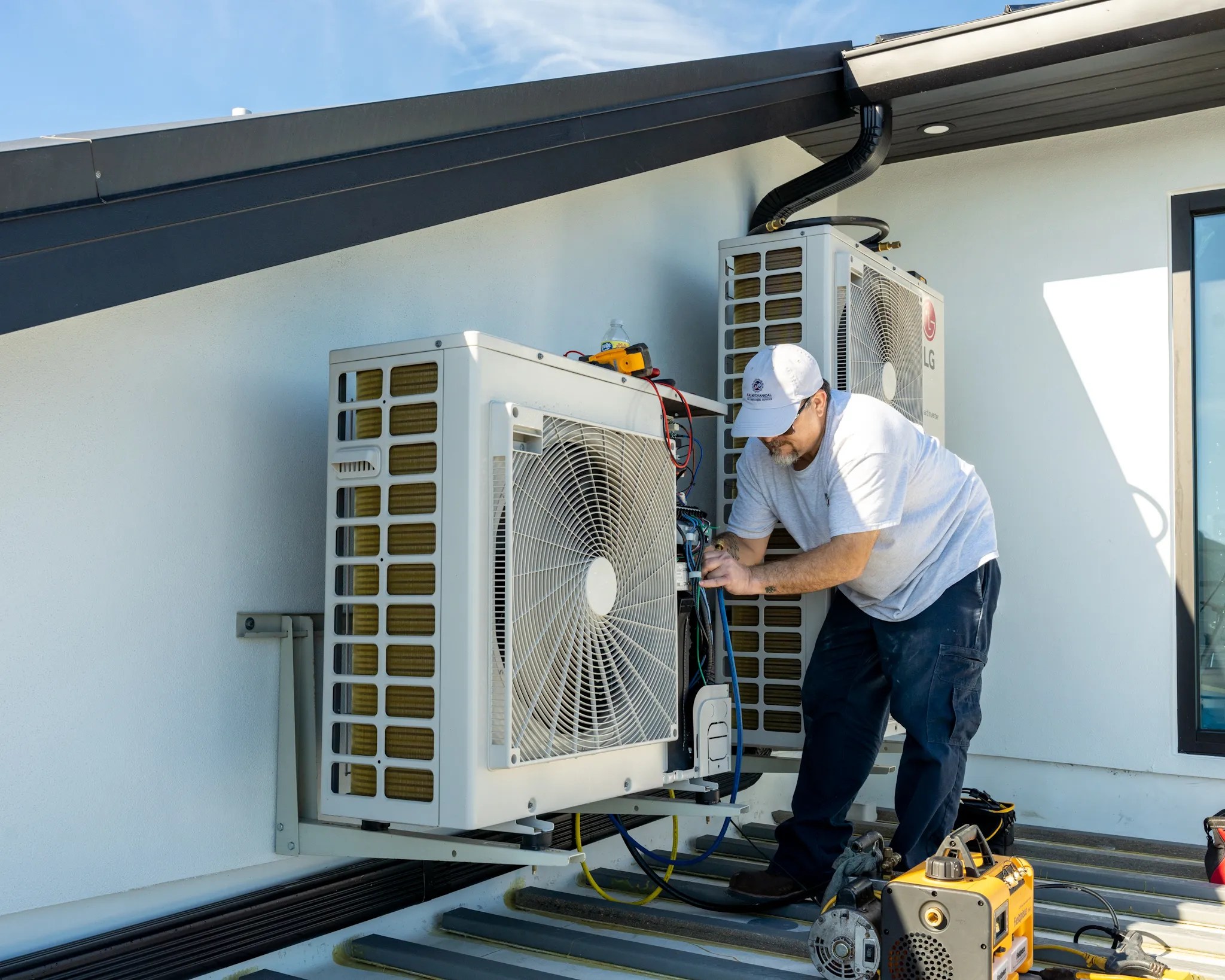
Picture your condenser doing a slightly different job. A fan pulls outdoor air across a refrigerant coil, the refrigerant absorbs heat from that air, a compressor raises its temperature, and a heat exchanger transfers that energy into water circulating from the pool. Same components as the condenser sitting beside your house, arranged for a different job. Because it relocates heat that already exists rather than manufacturing any, it delivers several units of heat energy for every unit of electricity consumed. An electric resistance heater delivers slightly less than one. That ratio is the entire argument.
The tradeoff is that capacity depends on how much heat is available in the outdoor air to begin with. Output falls as the air cools, and below roughly the mid-fifties most models become slow enough to be impractical. In Tampa Bay that constrains them for a few weeks in January and February. It leaves them well suited to the other ten months.
Why the Florida case is unusually strong
Long shoulder seasons are precisely where this equipment excels. Warm air to draw from, a modest temperature lift required to reach a comfortable 84 or 86 degrees, and a swimming season long enough to spread the equipment cost across many more heating hours than a northern owner would ever see. Gas heaters warm water faster and work regardless of air temperature, which makes them the right tool for a pool used unpredictably on winter weekends. For holding a temperature all season, they cost considerably more per hour to run.
Now the part nobody selling equipment leads with: a pool cover does more for your operating cost than any heater you can buy. Evaporation is the dominant heat loss from an open pool, far ahead of conduction into the ground or convection off the surface. Every gallon that evaporates carries away energy you paid for. Cover the pool overnight and you cut the load on whatever is heating it, whether that is a heat pump, a gas heater, or the sun.
Buy the cover before you upgrade the heater. We are not being cute about that.
Expect the temperature to move slowly, too, because that is what this technology does. A heat pump raises pool water a degree or two per day. It will not warm a pool in an afternoon, so you set it in October and leave it alone instead of firing it up the morning of a party. Owners who expect gas-heater responsiveness from a heat pump end up disappointed by equipment that is working correctly, and that mismatch of expectations causes more complaints than any actual defect we hear about.
Where this becomes an HVAC question
Here is the intersection that catches Tampa Bay homeowners. A pool heat pump is a substantial electrical load, frequently a dedicated 50-amp circuit, and plenty of older homes in this area carry panels sized for a different era of household demand. Add a pool heat pump to a panel already close to its limit and you may find yourself paying for a service upgrade you had not budgeted, discovered halfway through an installation.
That surprise is entirely predictable in advance, which is the frustrating part. If your house is likely to need an HVAC replacement in the next few years, and you are also contemplating a pool heat pump, plan both as one exercise. One load calculation covering both projects tells you whether the panel handles them and lets you sequence the work sensibly. Doing that math twice, years apart, is how people end up upgrading a panel they could have upgraded during the first project at lower total cost. Our guide to older homes and electrical panels goes deeper on what those panels can and cannot carry.
What the two systems share mechanically
- Salt exposure. Near the water, coils corrode on pool equipment exactly as they do on home condensers, and a pool heat pump within the first mile of salt water sits in air usually classed C4 or higher under ISO 9223, the same exposure your condenser faces. Coated coils and regular fresh-water rinsing are worth the trouble on both.
- Clearance. Both need open air around them. Landscaping grown in tight against a unit is the most common avoidable efficiency problem we find, in either context.
- Storm exposure. Outdoor equipment in a hurricane region, both vulnerable to surge. Surge protection is cheap compared with a control board.
- Sealed refrigerant circuits. This one matters. If either system is low on refrigerant, it leaked, because these are closed loops that do not consume charge. Recharging without finding the leak means paying for the same refrigerant twice, and it is worth knowing that R-410A is being phased down, so that repeat charge gets more expensive every year.
Where we come in
Everything on the home side of that fence is ours. The heat pump conditioning your house, the electrical load question when you are planning two projects at once, and the equipment placement that keeps airflow clear around whatever is sitting on your pad. If your pool equipment is fine and it is the house that will not keep up, that is a diagnosis worth doing properly rather than guessing at.
We work throughout Hillsborough, Pinellas, Pasco and Hernando counties, and we will tell you when a question belongs to your pool contractor instead of us.