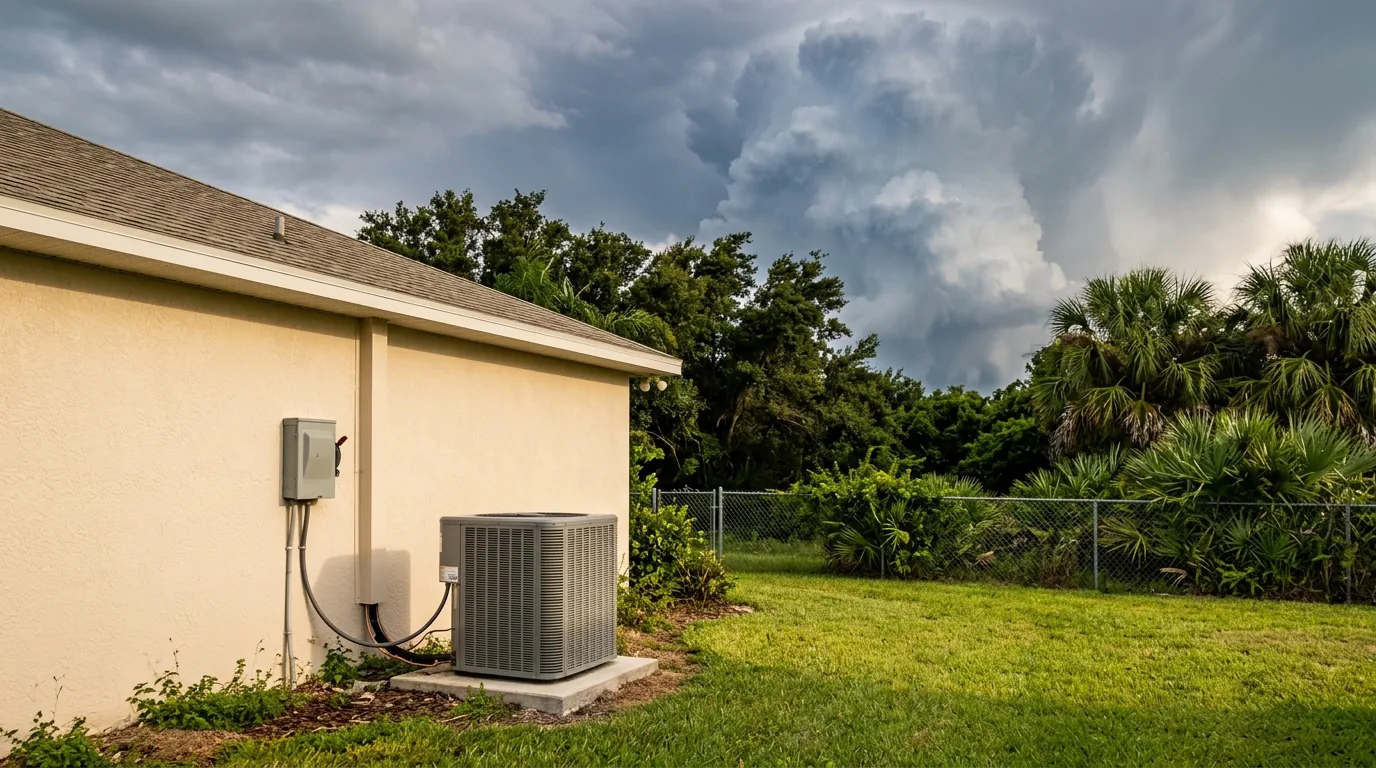
Start with the uncomfortable part: no surge protector will save your air conditioner from a direct lightning strike. Nothing sold for a house will. What a surge protector earns its keep against is the far more common event, the voltage spike that rides in when power is restored after an outage, and the small repeated surges from strikes a few streets over that quietly wear down a control board across a summer. Tampa Bay sits in the most lightning-active region in the country, and July and August afternoons are its season.
That distinction changes what you should buy and why.
A direct hit is not the design case
Lightning delivers current on a scale no residential device is rated to clamp. Hit the house or its service drop directly, and the current finds the weakest path no matter what sits at the condenser; that event is an insurance claim, not a prevention problem. It is also rare, even here.
What actually kills equipment is smaller and constant. When the utility re-energizes a neighborhood after an afternoon outage, the first moments of restoration are electrically messy, and the spike lands on every connected appliance at once. Strikes hitting a line or transformer blocks away induce surges too small to notice and too frequent to count. Neither destroys a board on the spot. They erode it, event by event, until a machine that "just stopped working" one Thursday actually died over eight weeks.
Inverter equipment raised the stakes
An air conditioner from 2005 was electrically simple: a contactor, a capacitor, two motors. Surges damaged those units on occasion, but the parts were minor and the machine had little electronics to lose.
Variable-speed and inverter-driven systems are different machines. Their compressors run on a board that converts and modulates power continuously, and that board is both far more sensitive to voltage events and one of the most expensive parts on the machine. Every point of efficiency you paid for lives on that board. So does the exposure.
Nobody mentions that trade during the sales conversation, and it is why surge protection moved from optional to baseline as the equipment changed.
Protect it in layers
The belt-and-suspenders answer is a whole-home surge protective device at the electrical panel plus a dedicated HVAC surge protector at the condenser disconnect. At the panel, the whole-home device clamps the big events for everything in the house; the dedicated unit catches what gets past it, along with anything induced on the wire run between panel and condenser.
For an inverter system, treat the dedicated unit at the disconnect as the minimum, not the upgrade.
Older homes complicate the panel end of this, because the panel itself can predate any provision for a surge device, and a few panel brands common in older Tampa Bay housing have problems well beyond surge protection. Which panels those are, and what an electrician looks for, is covered in our post on HVAC and your electrical panel.
After a close strike, diagnose before you power-cycle
Thunder arriving instantly with the flash means the strike was within a few hundred feet. If the system acts oddly after one of those, throwing a code, running without cooling, tripping its breaker, resist the standard reflex of cycling power until it behaves. Boards with surge damage can run in a degraded state, and repeated restarts push a marginal component into full failure. Book a diagnosis instead; a board caught while partly functional tells the technician far more than a dead one does.
This is not the hurricane conversation
Our hurricane season checklist leads with surge protection too, but for a named storm the advice is behavioral: shut the system down at the breaker before landfall and keep it off through the outage. Nobody does that for an ordinary Tuesday thunderstorm, and nobody should have to. Storms roll through several afternoons a week from June into September, the system runs through most of them, and the protection has to be the kind that works while you are at the office. That is the whole argument for hardware over habits.
Surge protectors also wear out. Their internal components sacrifice themselves clamping events, most units carry an indicator showing whether protection is still live, and a protector that has spent three summers on a Tampa Bay condenser has absorbed real hits. Checking that indicator belongs on every maintenance visit, which is the difference between owning protection and assuming it.
Boiled down, the position is short. A direct strike is fate. Everything else is engineering, and the engineering is a panel device, a disconnect device, and the habit of calling for a diagnosis instead of flipping the breaker when the sky has just finished shouting at your house.