Cooling is the largest line on almost every Tampa Bay power bill, and it stays largest from March through November. Eight or nine months of load is what makes small decisions worth making here. This article assumes your equipment is healthy and covers what you can change: how you set the thermostat, how you use fans and window coverings, what else on the panel is competing for the same dollars, and when an upgrade pays for itself. If your bill jumped and you suspect something is wrong, read the hidden faults that quietly raise a bill instead.
Chase dryness before you chase degrees
Seventy-eight degrees at 45 percent relative humidity feels better than 74 at 60 percent. That is not a preference, it is how evaporative cooling from your skin works, and it is the most useful thing a Florida homeowner can internalize about comfort. Every degree you drop the setpoint costs money on every cycle for eight months. Dry air is comfort you get without buying a lower number.
So before adjusting the temperature, try running the house a degree or two warmer for a week and paying attention to how it feels rather than what the display says. Most people find the ceiling is higher than they assumed.
One change costs nothing at all. Set the fan to AUTO rather than ON.
Setbacks work here, but not the way the internet says
Standard advice from a heating climate is to let the house drift a long way while you are out. Ten degrees, twelve, whatever. That advice does not travel well to Florida, and following it is one of the more common ways people spend more while trying to spend less.
Here is the mechanism. In a dry climate, a house that drifted up ten degrees only has to shed sensible heat when the system restarts, and that happens quickly. In our climate, that same drifting house has been absorbing moisture the whole time, into drywall, carpet, upholstery and every cardboard box in the closet. Your system now has to remove both the heat and all that accumulated water, and the latent load is the slow part. The recovery runs long, the compressor works at full tilt through the hottest part of the afternoon, and whatever you saved during the day gets handed back during the catch-up. Some houses never fully recover before evening.
Two or three degrees is the setback that works in Tampa Bay. Small enough that the house never gets damp, large enough to matter across eight months.
A programmable or smart thermostat makes that automatic, and the runtime logs are worth more than the app. Watch that number across weeks of similar weather. Steadily rising runtime is the earliest warning a homeowner ever gets that something needs attention.
Ceiling fans, with the one caveat everybody ignores
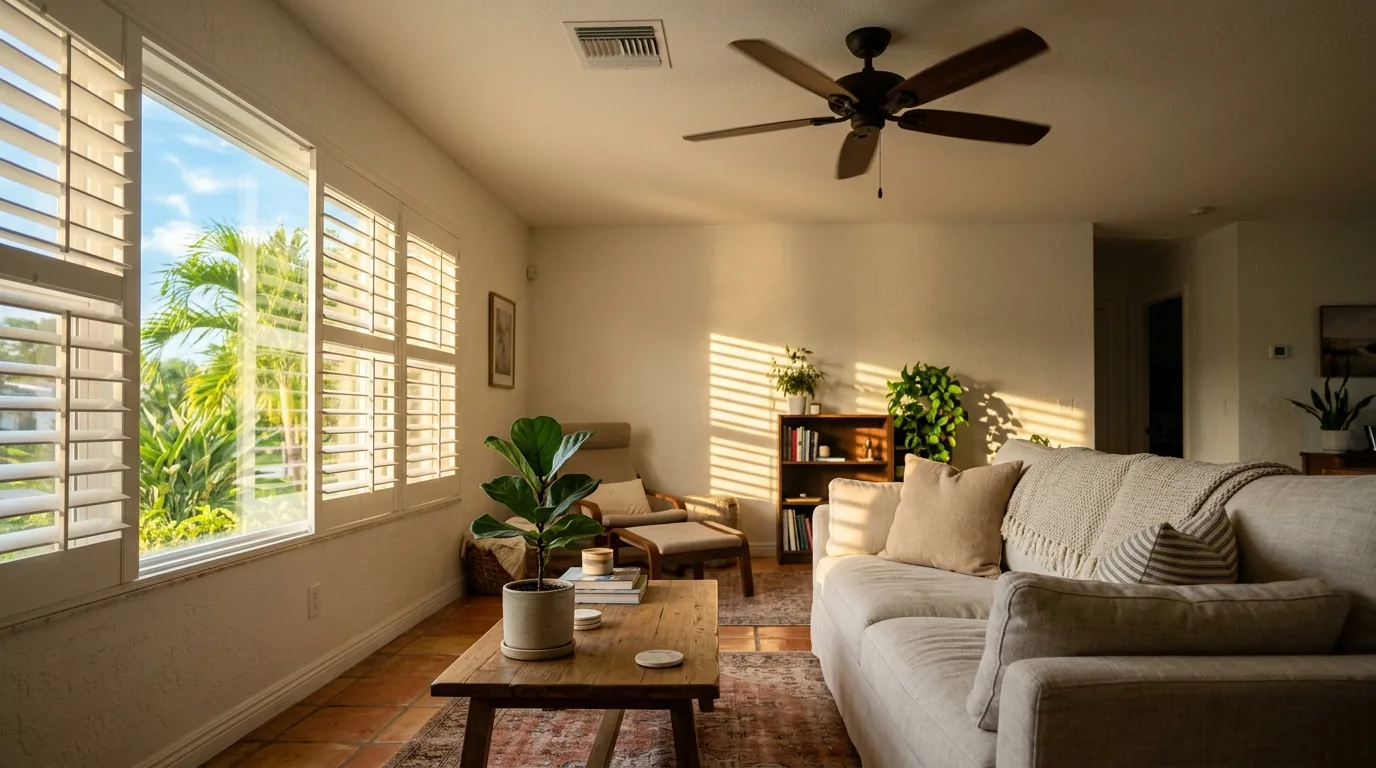
Fans cool people, not rooms. A ceiling fan moves air across skin and speeds evaporation, which is why a room feels several degrees cooler while you are sitting in it, and it lets you hold a higher setpoint for the same comfort. That part is real and it is cheap: a fan motor draws a tiny fraction of what a compressor draws.
The caveat is that a fan spinning in an empty bedroom is pure cost with zero benefit. Worse than zero, technically, since the motor adds a little heat to the room. Turn them off when you leave. In summer, run them counterclockwise viewed from below, so the air pushes down at you.
Stop the sun before it gets inside
West-facing glass takes full afternoon sun during the hottest hours of the day, which is exactly when your utility's demand is highest and your system is already working hardest. Solar heat gain through windows is a large share of the cooling load in a typical Florida house.
Order of effectiveness runs like this:
- Exterior shading wins. Awnings, solar screens, a well-placed tree. Stopping the energy before it passes the glass beats absorbing it indoors, which is what blinds do.
- Solar control film on the two or three worst windows is inexpensive, effective and mostly invisible once installed.
- Interior blinds and heavy curtains help, just less than people expect, because the heat is already in the room by then. Still worth closing on the west side after lunch.
- Attic insulation, if yours is thin or compressed, is often the single best envelope investment in an older house. See how insulation affects HVAC performance and what windows and doors actually cost you.
The rest of the bill is not all air conditioning
Worth saying, because homeowners regularly blame the AC for a bill that two other appliances helped build.
Your water heater is usually the second largest electrical load in the house. An electric tank set at scalding, in an unconditioned garage, with no insulation blanket, runs constantly to hold water nobody is using. Turning it down to a safe setting costs nothing.
Pool pumps deserve a harder look than they get. A single-speed pump running eight hours a day, every day, through a Florida summer is a large and completely silent load, and variable-speed pumps use dramatically less energy for the same turnover because pump power scales steeply with speed. Pool heaters are their own conversation, covered in pool heaters and heat pumps.
Look at what else runs all day before concluding the air conditioner is the villain.
Filter discipline, briefly
Change them every 30 to 60 days. Not on the schedule printed on the box, which assumes a system running a quarter as many hours as yours. A restricted filter starves the blower, drops airflow across the coil, and makes the equipment work longer for the same result. There is no cheaper habit available. Our filter guide covers what MERV rating your system can handle without choking.
When new equipment is the answer
Efficiency habits have a ceiling, and past a certain point you are optimizing a machine that cannot deliver. If the system is old, if repairs are stacking up, or if the house never gets dry no matter what you set, the equipment is the constraint.
Sequence matters more than most people realize. Seal the ducts and improve the envelope first, then size the replacement, because a house with a lower load may need a smaller and cheaper unit that dehumidifies better than the big one you would have bought. Do it in the other order and you have paid for capacity you no longer need, permanently. Florida requires 14.3 SEER2 minimum on new residential systems under 45,000 BTU, and variable-speed equipment removes far more moisture than a single-stage unit from fifteen years ago.
We handle efficiency work and installations across Hillsborough, Pinellas, Pasco and Hernando counties, and we will tell you which of the two your house needs.