Ten to fifteen years, and nearer the low end of that if you live within a mile of salt water. The number you see quoted nationally, fifteen to twenty, was not written for a state where the compressor runs eight or nine months a year. Equipment quality is not the difference. Hours and salt are.
Wear tracks run hours, not birthdays
Think of the compressor the way you would think of an engine. Nobody judges a car by the year on the title without looking at the odometer, and yet almost every conversation about air conditioner life starts with age alone. In most of the country a system works hard through June, July and August, coasts through a mild spring and fall, and sits idle from November to March. Here it starts in March and does not really stop until Thanksgiving. Some years it does not stop at all.
That is roughly double the annual run time. A Tampa Bay system entering its tenth summer has already logged what a system in Ohio takes fifteen or more years to accumulate, and the parts that fail first are the ones that count hours rather than calendar days: the compressor, the condenser fan motor, the contactor that pulls in every single time the unit starts.
Which is why replacement conversations start earlier down here, and why service intervals that sound aggressive in a national article are simply correct in ours.
Salt is the second clock, and it runs faster
Along the coast, corrosion routinely ends a system before anything mechanical wears out. The mechanism is worth understanding, because it explains why a well-maintained coastal unit still dies young.
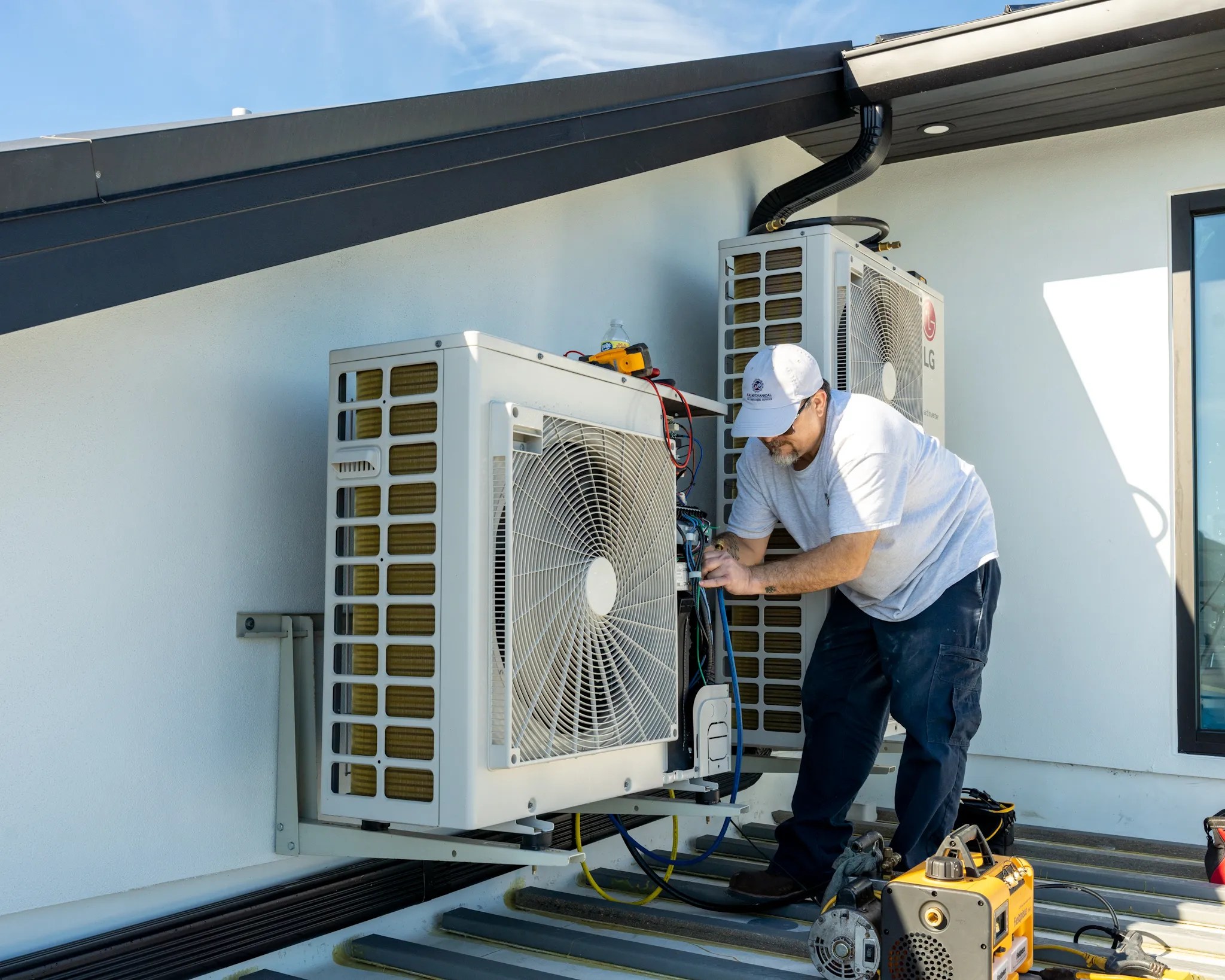
Salt aerosol settles on the aluminum fins of the outdoor coil and holds moisture against the metal. The fins thin, then perforate, then lose contact with the copper tubing they were bonded to. Heat that should be leaving the refrigerant stays in it. Head pressure climbs, capacity falls, and the compressor spends every cycle working against a coil that can no longer do its share of the job. You do not notice it as a failure. You notice it as a house that takes longer to cool each summer than it did the summer before.
On the ISO 9223 corrosivity scale, the first mile or so inland from salt water typically rates C4 or higher, meaning high atmospheric corrosivity. Inside that band, a factory-coated coil and a rinse schedule twice a year move the number. Our piece on salt air and your AC goes through what that protection consists of, and which neighborhoods sit inside the band is more specific than most people assume. Timber Pines, for instance, sits about three miles inland and does not need coastal-grade protection. Clearwater Beach very much does.
Aging normally versus aging badly
A system aging the way it should cools slightly less well each season, costs slightly more to run, and asks for a small repair every few years. That is not a warning sign. That is an air conditioner doing what air conditioners do.
These are the signs that something is wrong, not merely old:
- Refrigerant that keeps disappearing. A sealed system does not consume refrigerant the way an engine consumes oil. If it needed a charge two summers running, there is a leak nobody has located, and you are paying for the same gas twice.
- Capacitors or contactors that fail repeatedly. Once in a decade is ordinary wear. Twice in three years means something upstream, usually heat, low voltage or restricted airflow, is cooking the part.
- Ice on the line set after you changed the filter. Points at undercharge or a restriction, not at dirt.
- Humidity that never comes down. Usually a sizing problem, and sizing does not improve with age.
- Longer run times in identical weather. The single most useful early warning available to a homeowner, and the reason a thermostat that logs runtime pays for itself.
Two or more of those together, on equipment past twelve, is a system telling you something.
What buys you extra years
Not much of this is exotic. All of it is cheaper than the replacement it postpones.
Service annually inland and twice a year within that coastal mile, because the outdoor coil is where the damage accumulates and a rinse is only useful if it happens before the corrosion sets. Change filters every 30 to 60 days rather than on the box's schedule, which was written for a house that runs its system a quarter as much as yours does. Keep at least two feet of clear space around the condenser, since hibiscus and areca palm grow fast here and a coil breathing its own exhaust runs hot all season. Seal the ducts so the equipment is not quietly fighting losses into a 130 degree attic. And put a surge protector on the outdoor unit, because this is one of the most lightning-prone regions in the country and a control board is an expensive thing to lose to a strike two streets over.
Scheduled maintenance does one more thing that gets overlooked. It creates the documented service history that most manufacturer warranties require, which is exactly the paperwork you will be asked for on the day a compressor fails in year eight.
The line between repairing and replacing
Three things decide it: what the repair costs relative to the equipment, how old the system is, and which refrigerant is inside it.
A capacitor on a healthy eight-year-old unit is worth doing without hesitation. A compressor or an evaporator coil on a thirteen-year-old unit almost never is, because you are buying a repair on a machine whose remaining parts are all the same age as the one that just failed. Somewhere between those two extremes is a genuine judgment call, and the refrigerant tips it. R-410A is being phased down, with R-454B and R-32 taking over in new equipment, so a system holding R-410A is a system whose future refrigerant top ups get less convenient, not more. We wrote up what that transition means for existing systems separately.
Ask for the diagnosis in writing, with the failed component named. Then decide.
Our guide to when replacement makes sense lays out the full comparison, and installation covers what a correctly done replacement involves. We work across Hillsborough, Pinellas, Pasco and Hernando counties.