When the air conditioning quits in a house, the family is uncomfortable for an afternoon. When it quits in a Tampa restaurant, a medical suite or a retail unit in August, you stop trading. That gap is the whole argument for treating commercial HVAC as a business continuity question rather than a facilities line item, and it is why the decisions that make sense in a home make very little sense on a rooftop.
The repair invoice is almost never the expensive part.
Where the money goes
Nobody can give you an honest figure per hour for downtime, because the number depends entirely on what your business does and when it happens. What we can do is name the mechanisms, because once you can see them you can price them for your own operation better than any consultant could.
Lost trade is the obvious one. Customers who walk into a hot dining room walk back out, and a proportion of them do not come back next month either, which is a cost that outlives the outage by a long way. Staff are the next layer: people are on the clock whether or not there is work for them to do, and sending a shift home does not always end the obligation to pay it.
Stock is where food service gets hurt fastest. Walk-in coolers are separate systems, but ambient temperature in a kitchen affects prep areas, dry storage and anything sitting on a line, and product that has to be discarded is a direct write-off on top of everything else. In medical and dental settings the exposure looks different again, since temperature and humidity limits apply to some medications and materials, and a schedule full of rescheduled appointments creates a backlog that takes weeks to clear.
Landlords carry a version of this too. Tenant complaints escalate into lease disputes, rent abatement claims and renewals that quietly do not happen.
Then there is damage the outage does to the building itself. Florida humidity does not wait politely for the repair, and a commercial space with no dehumidification for several days in July will develop condensation on cold surfaces, swollen millwork, and the beginnings of a mold problem that costs far more to remediate than the compressor did to replace. Server closets and IT rooms fail on their own timetable, usually faster.
Commercial equipment wears out differently
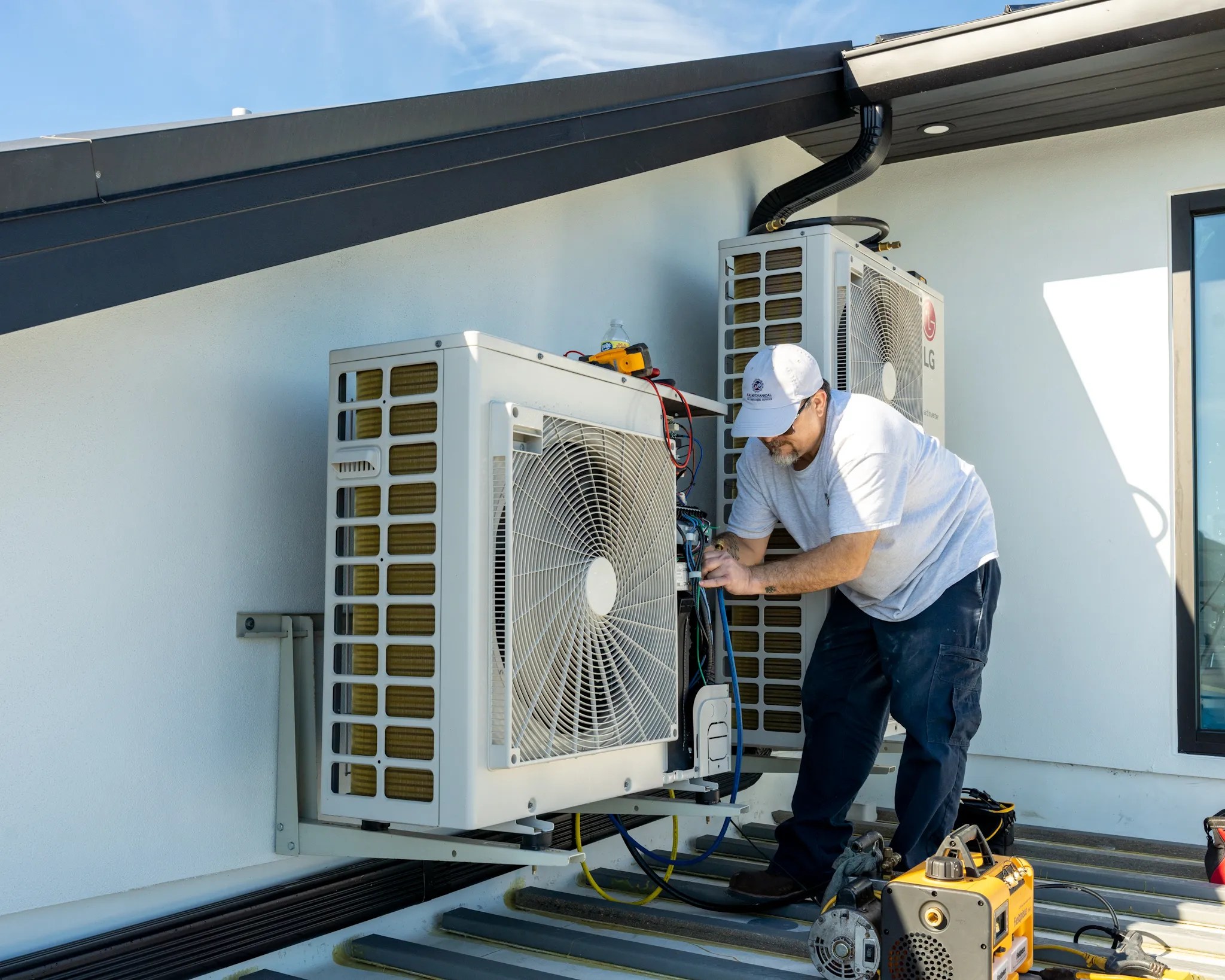
A packaged rooftop unit on a Tampa Bay retail building accumulates run hours at a rate no residential system approaches. Extended occupancy, high internal loads from lighting and cooking and equipment and bodies, and ventilation requirements no house carries all keep it working. Wear tracks hours, not birthdays. So a failure mode that takes a decade to develop in a home shows up in a couple of seasons on a roof, and the maintenance interval that suits a house is simply the wrong interval here.
Exposure compounds it. That unit sits in full sun with no shade, takes wind-driven rain directly into its cabinet, and within about a mile of salt water lives in air that corrosion engineers would generally grade C4 or worse on the ISO 9223 scale. A residential condenser at least gets the shelter of a house wall and a bit of landscaping. A rooftop unit gets nothing.
Belts, bearings and motors are consequently the components that produce most unplanned commercial calls, and all three announce themselves before they fail. Nobody hears them, because nobody goes on the roof.
Schedule around your hours, not the contractor's
Replacing a rooftop unit on a Sunday takes the same labor as replacing it on a Tuesday. One of those days closes your business and one does not. Any planned commercial work should be quoted around your operating hours, including evenings, weekends and overnight where the building allows it, and that arrangement should not be treated as an exotic favor.
Maintenance follows the same logic. A technician working across a dining room floor at noon does a worse job, more slowly, with more disruption, than the same technician working at seven in the morning with the building empty.
What a real commercial maintenance program covers
The residential model of one visit a year does not transfer. A program worth paying for is built around your equipment's run hours and your building's environment, and it should specify at minimum:
- Visit frequency derived from run hours and load, not from a default annual interval borrowed from residential work. Continuously occupied buildings and kitchens need more.
- Written condition reports. This is the part owners undervalue most. A documented record of what is aging turns capital replacement into something you budget for over two years instead of something that ambushes you on a Friday in July, and it gives you the evidence to justify the spend to a board or a lender.
- Filter intervals matched to the actual environment. A commercial kitchen loads filters at a completely different rate from an accounting office in the same plaza.
- Belt, bearing, motor and drive inspection on anything that runs continuously.
- Refrigerant charge verification. A slow leak on a rooftop unit degrades capacity and wastes energy for months before anyone in the building notices, and by then the compressor has been running hot the whole time.
- Coil cleaning on a schedule, which matters far more near salt water than most owners expect.
- Priority response terms written down in advance, so that when something does fail you are executing an agreement rather than negotiating one.
Standardizing across a portfolio
Owners with several buildings, or one building with a row of identical rooftop units, get a compounding return from putting all of it on one manufacturer. Parts inventory covers everything instead of one thing. Technicians know the controls without reading a manual. Replacements get sequenced across the portfolio on a rolling plan, not handled one panic at a time.
We are factory-certified on Carrier, Goodman, Rheem, LG, Midea, Trane, Daikin, Mitsubishi and Lennox, and standardizing on any of those is a reasonable strategy.
The cheapest replacement is the one you chose
Emergency replacement is expensive in every direction at once. You take whatever equipment is sitting on a distributor's floor, whether or not it fits the building, you pay for the urgency, you get no time to compare efficiency options that would have paid you back for fifteen years, and you close while it all happens.
Aging equipment should come out in a shoulder season, on a date you picked, from a plan you wrote a year earlier.
Talk to us about commercial HVAC service, commercial maintenance programs, or emergency response if something is down right now. We work across the Tampa Bay area, and every cost is quoted before work begins.