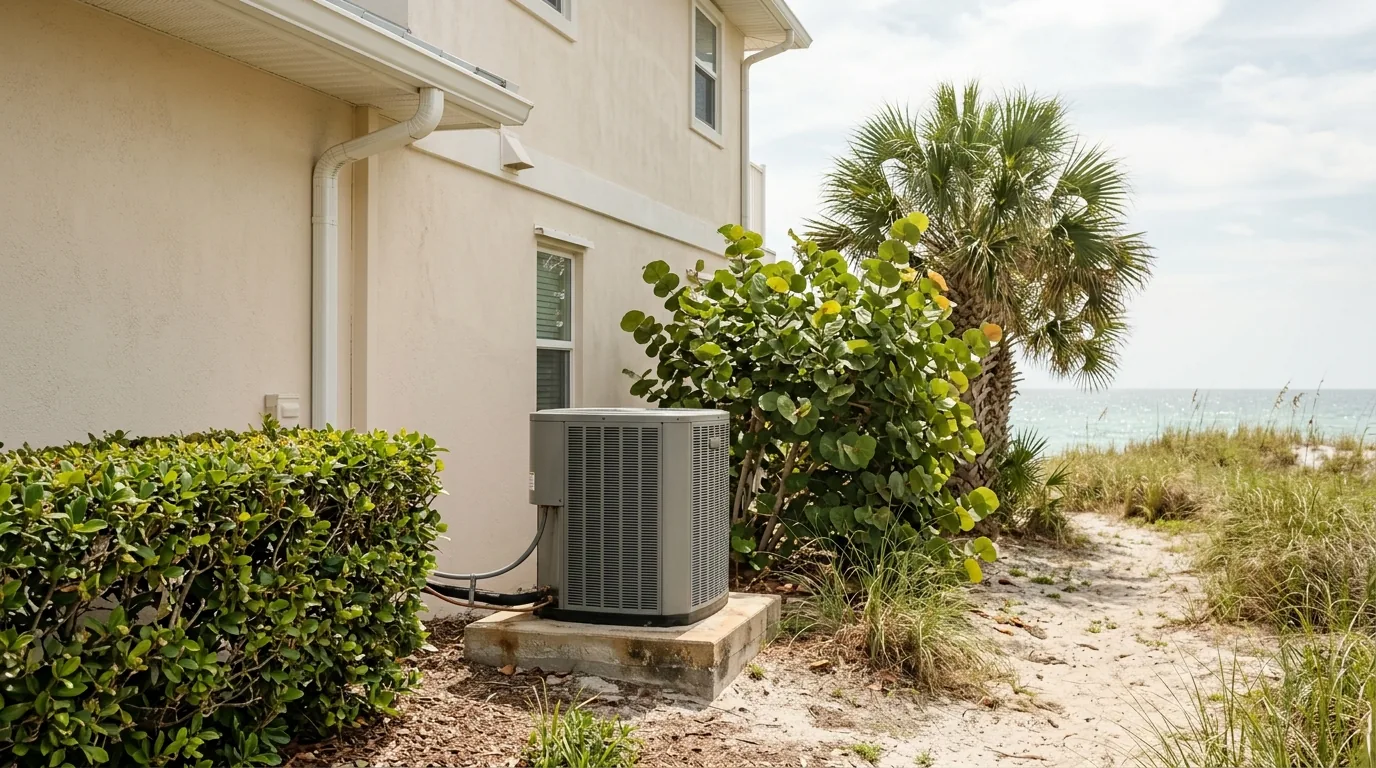
Barrier island installations are the harshest work we do. Clearwater Beach, Sand Key, Indian Rocks, Indian Shores, Redington, Treasure Island: open Gulf on one side, intracoastal on the other, and nowhere on any of them sheltered from salt.
Everything here applies less on the Clearwater mainland and hardly at all a few miles inland. That gradient is steep, and it matters more than the town name on your mail.
What salt does to a condenser
Worth understanding the mechanism, because it explains why the standard advice does not go far enough on an island. Airborne salt settles on the outdoor coil and stays there. Aluminum fins sit in direct contact with copper tubing, and salt in the presence of moisture drives corrosion between two dissimilar metals. Fins go first: they thin, they lose thermal contact with the tubing, and eventually they perforate. Since the coil's entire job is moving heat from refrigerant into outside air, losing fin surface loses capacity directly and permanently.
Nothing fails, though. That is the trap.
The compressor runs. The fan turns. The system produces cold air, just less each year, for more electricity. Owners typically notice in the fourth or fifth summer, and by then repair is rarely economical.
What to specify on an island installation
- A coated coil, without exception. On the mainland this is worth considering. Out here it is the difference between equipment that reaches the end of its warranty period and equipment that does not, and it is the single most effective decision you make at purchase.
- Corrosion-resistant cabinet hardware. Screws and panel fixings rust out before the equipment does, and a cabinet nobody can open cleanly makes every future service call worse and slower.
- Elevation, where flood risk allows. Out of standing water, out of the worst ground-level spray.
- Placement on the leeward side if the layout permits. It will not eliminate exposure. It reduces the dose.
- Surge protection. Not a salt issue, but this region gets extraordinary lightning and modern inverter boards do not survive it.
Twice a year is the baseline, not the upsell
Inland systems do fine on an annual visit. Island systems need two, and the mid-season one matters more, because it interrupts corrosion rather than merely recording it.
A proper coastal visit rinses the coil instead of glancing at it, inspects the fins and tells you how much coil is left, checks the cabinet and hardware, and clears the condensate system. If your maintenance appointment does not end with the coil clean, it was not a coastal maintenance appointment.
Between visits, rinse it yourself. Plain water, power off at the disconnect first. Cheapest thing on this page, and almost nobody does it.
Worth being specific about how, because the wrong technique does harm. Kill the power at the disconnect box beside the unit, not only at the thermostat. A garden hose at ordinary pressure is the right tool; a pressure washer is the wrong one, since it folds the soft fin pack flat and whatever it touches stops passing air for good. Where the cabinet top lifts off easily, wash from the inside out so salt leaves the way it came in. Where it does not, send water straight through the coil face at a right angle. Stop when the runoff turns clear. And leave the spray-on coil cleaners at the store: the caustic chemistry in most of them eats the one metal in the unit you are trying to keep. A hose, once a month, all summer.
What you can check yourself before calling
Island equipment gives warnings, and three of them are visible from your back step.
- Chalky white deposit on the fins. That is aluminum oxide, and it means corrosion is under way, not pending.
- Fins that flake or crumble when you touch them lightly. A coil at that stage is losing capacity every season and no cleaning restores it.
- Air coming off the top of the unit that is barely warm on a hot afternoon. A healthy condenser throws genuinely hot air. Weak discharge with the compressor clearly running means the coil is not rejecting heat, which is either fouling, which cleans, or fin loss, which does not. The distinction is worth knowing before you spend anything, because one of them costs a hose and the other one costs a system.
Condominium and rental realities
Much of the island housing is condominium or seasonal rental, which adds two constraints that have nothing to do with mechanics.
Association rules frequently govern equipment placement, screening, noise and roof access. Finding out what is permitted before ordering avoids an expensive reversal.
And empty properties are their own hazard. A seasonal home left with the air conditioning switched off through a Florida summer is how people come back to mold. Leave the system running to control humidity, and clear the condensate line before you go, because a blocked drain trips the float switch and shuts everything down for the rest of the season with nobody there to notice. See preparing for a long absence.
Storm exposure is part of the specification
Islands take surge and flooding first, so two things are worth settling in advance.
Submerge a condenser in salt water and you own a replacement, however well it runs the next morning. Brine left inside windings, boards and bearings keeps corroding long after the water recedes, so the failure arrives on a delay measured in weeks or months. "It still works" is not evidence it survived. It is evidence it has not finished dying, and settling that before storm season beats arguing about it after one.
Securing the unit to its pad matters too, and knowing whether yours is secured matters more. Both are cheaper to sort out in spring than during a watch. See the hurricane checklist.
Permitting on the islands
Clearwater and each of the beach municipalities run their own building departments, and an equipment changeout needs a mechanical permit and an inspection wherever you are. The island-specific part is flood zone review. Most of this housing sits in a mapped zone, and it is the current flood rules, not the ones in force when the house went up, that decide the elevation and anchoring of anything newly installed.
That is the piece owners find surprising. A condenser that spent twenty years on a ground-level pad usually cannot legally go back at grade; the replacement gets a stand, engineered anchoring, or both.
None of that is an obstacle. It is a line item, and it belongs in the quote rather than in a phone call after the inspection.
A realistic expectation
With a coated coil and twice-yearly service, island equipment can reach a normal service life. Without both, eight to twelve years is common, and the thing that ends it will be the coil rather than anything mechanical.
None of that is pessimism. Put the money where it does something, which out here means coil specification and service frequency, not capacity you will never use.
See HVAC service in Clearwater, Indian Rocks Beach, Treasure Island, and what coastal maintenance covers.