SouthShore is unusual because it has two entirely different HVAC situations running at once, sometimes on the same street.
There is real saltwater exposure along the Tampa Bay shoreline, and there is a large volume of construction from the last fifteen years further inland. Advice written for one actively misleads the owner of the other, which is why a generic "Florida HVAC tips" article is close to useless out here.
It is Tampa Bay, not the Gulf
Apollo Beach, Ruskin and Gibsonton front Tampa Bay and Hillsborough Bay, not the open Gulf. Worth naming correctly, because copy telling an Apollo Beach homeowner about "the Gulf breeze" was obviously written from a spreadsheet by somebody who has never been here.
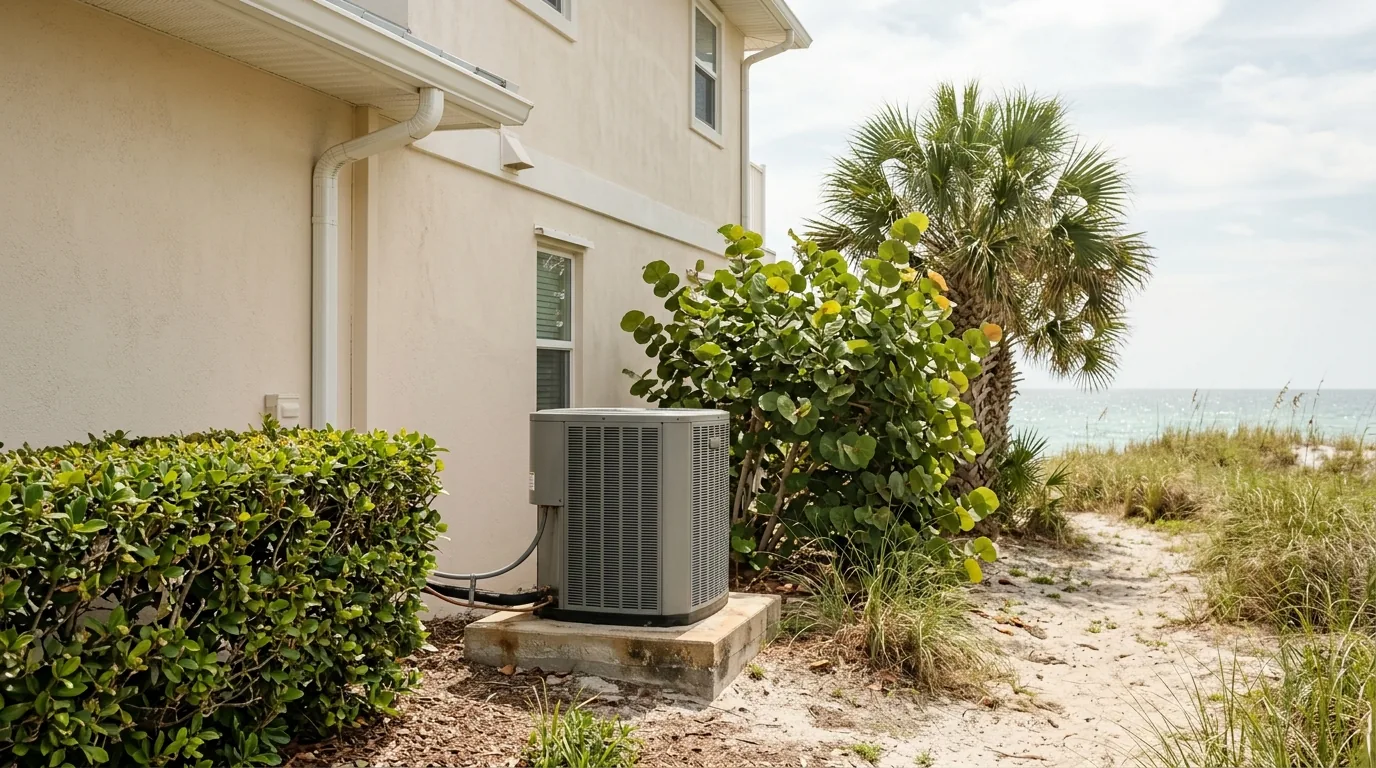
The corrosion advice does not change, though. Corrosion engineers put the Tampa Bay shoreline at C4 or higher on the ISO 9223 corrosivity scale, the same territory as open coast, and that exposure runs roughly a mile inland. Waterfront and canal-front properties get the full treatment: coated coils on replacement, coil service twice a year, fin condition checked on every visit, not every other one.
Two miles inland toward Sun City Center or Wimauma, none of it applies.
Canal-front properties
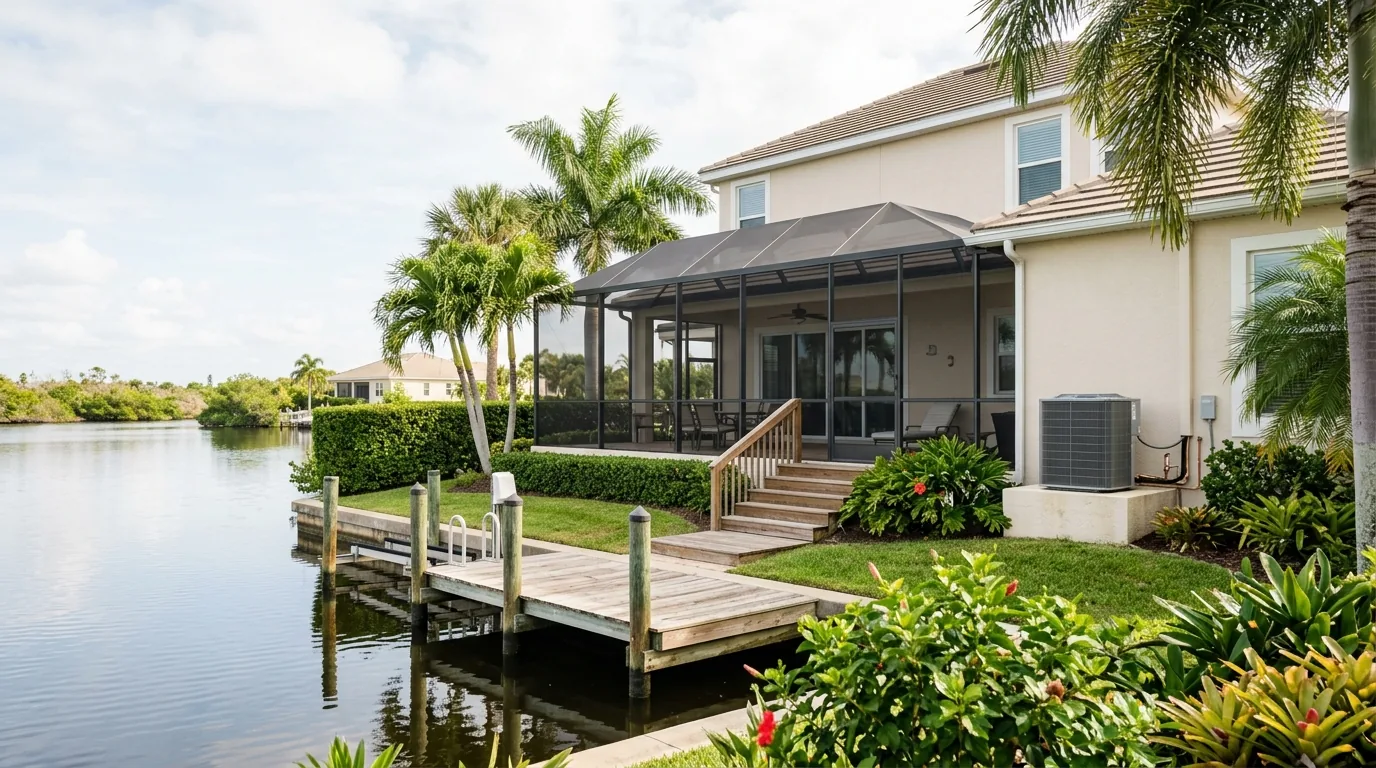
Much of Apollo Beach is built on canals, which puts equipment close to water on more than one side of the house, and two things follow from that.
Exposure runs higher than a simple distance-from-shore figure suggests, because the water is not only at the coast, it is in the neighborhood. And flood risk is real, which makes condenser elevation a decision to make at installation, not something to regret after a flood.
A condenser that has stood in salt water is a replacement, not a repair.
Even if it runs afterwards. Salt water in electrical components and bearings causes a failure that comes on slowly, not all at once, so "it still works" tells you nothing about whether it survived, and we would rather have that conversation in April than in October.
What a service visit looks like on the water
The visible difference between a bayfront maintenance call and an inland one is how much time goes into the outdoor unit. On a canal-front house the technician takes panels off rather than spraying through the guard, rinses the coil from the inside outward so salt exits the way it entered, then inspects what is left of the fin pack and tells you what it found. That last report is the number that predicts the system's remaining life, and it is the one most owners have never been given.
Cabinet hardware gets checked at the same time. Screws and panel fixings on a canal-front unit corrode faster than the coil does, and a unit whose fasteners have seized turns every future repair into a longer, more expensive job.
Indoors it is the ordinary list: charge verified against measured conditions, capacitor tested, contactor contacts inspected for pitting, blower wheel and evaporator checked, drain line cleared.
Between visits, rinse the condenser yourself with a plain garden hose, power off at the disconnect. No pressure washer, which flattens fins permanently, and no coil chemicals, most of which are alkaline and attack the aluminum you are trying to protect. Monthly through the summer is enough.
The new-construction half
Inland SouthShore has absorbed a great deal of subdivision building. The equipment is modern and usually installed correctly, and the recurring issues are the ones common to new construction everywhere in this region.
- Upstairs runs warmer in two-story houses on a single unzoned system with a downstairs thermostat.
- Bedrooms with no return path that underperform the moment the door closes.
- Oversizing, which produces a house that reaches setpoint easily and still feels clammy, because the system never runs long enough to pull the moisture out.
- Unregistered equipment, where the extended parts warranty quietly lapsed in the first 90 days because nobody told the owner registration was their job rather than the builder's.
That last one is worth acting on today if your house is under three years old. See warranty service and new construction HVAC.
There is a test for the closed-door problem that costs nothing. Shut a bedroom door with the system running and hold a sheet of paper against the gap underneath. Strong suction pulling it flat means the room has supply air going in and nowhere for it to leave, which pressurizes the room, chokes the supply, and leaves it several degrees warm by afternoon. Undercutting the door, adding a transfer grille, or fitting a jumper duct all fix it, and none of them involves touching the equipment.
Sun City Center is its own case
Sun City Center is a large active-retirement community and the practical considerations differ from the rest of SouthShore, though the mechanics do not.
Heat is a health matter here, not a comfort one, so an August failure is urgent. Many properties also sit empty seasonally and need the system running to control humidity rather than switched off at the breaker, which is the opposite of what most owners assume. And community rules govern placement and screening, narrowing the options before anyone quotes anything.
None of that changes what the equipment needs. It changes how fast the phone should be answered.
Storm exposure is above average here
Low-lying bayfront geography means SouthShore sees surge and flooding sooner than most of the region, and two pieces of preparation belong in spring, not during a hurricane watch: confirming the outdoor unit is properly secured to its pad, and fitting surge protection at the unit. This area takes a great deal of lightning, and the control boards in modern inverter equipment do not survive it.
Permits and inspection here
Apollo Beach, Ruskin, Gibsonton, Sun City Center and Wimauma are all unincorporated, so mechanical permits go through Hillsborough County and an inspection follows the work. Standard for any changeout anywhere.
Flood zone review is the local wrinkle. It applies across much of the bayfront and canal housing here, and where it does, the rules govern how high the outdoor unit must be mounted and how it is anchored, and they apply to the new installation regardless of how the old one sat. Owners replacing a condenser that has been at grade since the house was built are frequently surprised to learn the replacement goes on a raised stand.
Better to price that at the quote than to discover it after the inspector has been.
Which situation are you in
The useful question out here is not "what is the advice for this area" but "which of the two am I".
Within about a mile of the bay, or on a canal, corrosion governs everything and the money belongs in coil specification and service frequency. Further inland in newer construction, corrosion is close to irrelevant and the money belongs in airflow, zoning, and getting the warranty registered before the window shuts.
See Apollo Beach, Ruskin, Sun City Center, and what coastal maintenance covers.